-
Question 1
Correct
-
Noradrenaline exhibits its positive inotropic effect by which of the following mechanisms:
Your Answer: Binds to beta1-receptors and causes increased Ca2+ entry via L-type channels during the action potential
Explanation:Noradrenaline (the sympathetic neurotransmitter) is a positive inotrope; it binds to β1-adrenoceptors on the membrane and causes increased Ca2+entry via L-type channels during the AP and thus increases Ca2+release from the SR. Noradrenaline also increases Ca2+sequestration into the SR and thus more Ca2+is available for the next contraction. Cardiac glycosides (e.g. digoxin) slow the removal of Ca2+from the cell by inhibiting the membrane Na+pump which generates the Na+gradient required for driving the export of Ca2+; consequently the removal of Ca2+from the myocyte is slowed and more Ca2+is available for the next contraction. Acidosis is negatively inotropic, largely because H+competes for Ca2+binding sites.
-
This question is part of the following fields:
- Cardiovascular
- Physiology
-
-
Question 2
Incorrect
-
A patient who is taking ramipril for high blood pressure complains of a dry persistent cough. What is the mechanism of cough in ACE inhibitor therapy:
Your Answer: Increased histamine release
Correct Answer: Decreased bradykinin breakdown
Explanation:Blocking ACE also diminishes the breakdown of the potent vasodilator bradykinin which is the cause of the persistent dry cough. Angiotensin-II receptor blockers do not have this effect, therefore they are useful alternative for patients who have to discontinue an ACE inhibitor because of persistent cough.
-
This question is part of the following fields:
- Cardiovascular
- Pharmacology
-
-
Question 3
Correct
-
Adenosine is primarily indicated for which of the following:
Your Answer: Paroxysmal supraventricular tachycardia
Explanation:Adenosine is usually the treatment of choice for terminating paroxysmal supraventricular tachycardia including those associated with accessory conduction pathways e.g. Wolff-Parkinson-White syndrome.
-
This question is part of the following fields:
- Cardiovascular
- Pharmacology
-
-
Question 4
Correct
-
Cardiac myocytes are connected to each other by which of the following:
Your Answer: Intercalated discs
Explanation:Adjacent cardiac myocytes are connected to each other by intercalated discs. The intercalated discs provide both a structural attachment by ‘glueing’ cells together at desmosomes and an electrical contact made up of proteins called connexons, called a gap junction, which essentially creates a low-resistance pathway between cells.
-
This question is part of the following fields:
- Cardiovascular
- Physiology
-
-
Question 5
Incorrect
-
Which of the following medications may lessen warfarin's anticoagulant effect:
Your Answer: Acute alcohol consumption
Correct Answer: Phenytoin
Explanation:Phenytoin will decrease the level or effect of warfarin by affecting hepatic/intestinal enzyme CYP3A4 metabolism.
Metronidazole will increase the level or effect of warfarin by affecting hepatic enzyme CYP2C9/10 metabolism.
NSAIDs, when given with Warfarin, increase anticoagulation. -
This question is part of the following fields:
- Cardiovascular
- Pharmacology
-
-
Question 6
Correct
-
Intracellular [Ca2+] rise in cardiac excitation-contraction coupling is mainly as a result of:
Your Answer: Ca 2+ release from sarcoplasmic reticulum
Explanation:Although Ca2+entry during the action potential (AP) is essential for contraction, it only accounts for about 25% of the rise in intracellular Ca2+. The rest is released from Ca2+stores in the sarcoplasmic reticulum (SR). APs travel down invaginations of the sarcolemma called T-tubules, which are close to, but do not touch, the terminal cisternae of the SR. During the AP plateau, Ca2+enters the cell and activates Ca2+sensitive Ca2+release channels in the sarcoplasmic reticulum allowing stored Ca2+to flood into the cytosol; this is called Ca2+-induced Ca2+release. The amount of Ca2+released is dependent on how much is stored, and on the size of the initial Ca2+influx during the AP.
-
This question is part of the following fields:
- Cardiovascular
- Physiology
-
-
Question 7
Correct
-
Digoxin exhibits its positive inotropic effect by which of the following mechanisms:
Your Answer: Inhibits the Na+/K+ pump on the myocyte membrane
Explanation:Cardiac glycosides (e.g. digoxin) slow the removal of Ca2+from the cell by inhibiting the membrane Na+pump (Na+/K+ATPase) which generates the Na+gradient required for driving the export of Ca2+by Na+/Ca2+exchange; consequently the removal of Ca2+from the myocyte is slowed and more Ca2+is available for the next contraction.
-
This question is part of the following fields:
- Cardiovascular
- Physiology
-
-
Question 8
Correct
-
Nitric oxide release from endothelium is stimulated by all of the following EXCEPT for:
Your Answer: Noradrenaline
Explanation:Nitric oxide (NO) production by the endothelium is increased by factors that elevate intracellular Ca2+, including local mediators such as bradykinin, histamine and serotonin, and some neurotransmitters (e.g. substance P). Increased flow (shear stress) also stimulates NO production and additionally activates prostacyclin synthesis. The basal production of NO continuously modulates vascular resistance; increased production of nitric oxide acts to cause vasodilation. Nitric oxide also inhibits platelet activation and thrombosis.
-
This question is part of the following fields:
- Cardiovascular
- Physiology
-
-
Question 9
Incorrect
-
Which of the following is NOT a typical electrolyte disturbance caused by furosemide:
Your Answer: Hypomagnesaemia
Correct Answer: Hypercalcaemia
Explanation:Adverse effects of loop diuretics include:
Mild gastrointestinal disturbances, pancreatitis and hepatic encephalopathy
Hyperglycaemia
Acute urinary retention
Water and electrolyte imbalance
Hyponatraemia, hypocalcaemia, hypokalaemia, hypomagnesaemia, hypochloraemiaHypotension, hypovolaemia, dehydration, and venous thromboembolism
Metabolic alkalosis
Hyperuricaemia
Blood disorders (bone marrow suppression, thrombocytopenia, and leucopenia)
Visual disturbance, tinnitus and deafness
Hypersensitivity reactions -
This question is part of the following fields:
- Cardiovascular
- Pharmacology
-
-
Question 10
Correct
-
What is the correct adrenaline dose for a patient with pulseless ventricular tachycardia?
Your Answer: 10 ml of 1 in 10,000 adrenaline solution
Explanation:Ventricular fibrillation or pulseless ventricular tachycardia (VF/VT) are referred to as shockable rhythm.
IV adrenaline 1 mg (10 mL of 1:10,000 solution) should be administered after 3 shocks and every 3 – 5 minutes/after alternate shocks thereafter for a shockable rhythm.
For a non-shockable rhythm, 1 mg IV adrenaline should be administered as soon as IV access is obtained, and then every 3 – 5 minutes/after alternate shocks thereafter.
-
This question is part of the following fields:
- Cardiovascular
- Pharmacology
-
-
Question 11
Correct
-
What is nimodipine used predominantly in the treatment of?
Your Answer: Prevention and treatment of vascular spasm following subarachnoid haemorrhage
Explanation:Nimodipine is a smooth muscle relaxant that is related to nifedipine, but the effects preferentially act on cerebral arteries. It is exclusively used for the prevention and treatment of vascular spasm after an aneurysmal subarachnoid haemorrhage.
-
This question is part of the following fields:
- Cardiovascular
- Pharmacology
-
-
Question 12
Correct
-
Digoxin is contraindicated in all of the following EXCEPT for:
Your Answer: Asthma
Explanation:Digoxin is contraindicated in:Supraventricular arrhythmias associated with accessory conduction pathways e.g. Wolff-Parkinson-White syndromeVentricular tachycardia or fibrillationHeart conduction problems e.g. second degree or intermittent complete heart blockHypertrophic cardiomyopathy (unless concomitant atrial fibrillation and heart failure but should be used with caution)
-
This question is part of the following fields:
- Cardiovascular
- Pharmacology
-
-
Question 13
Incorrect
-
Which of the following is NOT a common side effect of adenosine:
Your Answer: AV block
Correct Answer: Yellow vision
Explanation:Common side effects of adenosine include:
Apprehension
Dizziness, flushing, headache, nausea, dyspnoea
Angina (discontinue)
AV block, sinus pause and arrhythmia (discontinue if asystole or severe bradycardia occur) -
This question is part of the following fields:
- Cardiovascular
- Pharmacology
-
-
Question 14
Correct
-
What is the mechanism of action of captopril:
Your Answer: Inhibition of the conversion of angiotensin I to angiotensin II
Explanation:Angiotensin-converting enzyme inhibitors (ACE inhibitors) e.g. captopril inhibit the conversion of angiotensin I to angiotensin II, and thus have a vasodilatory effect, lowering both arterial and venous resistance. The cardiac output increases and, because the renovascular resistance falls, there is an increase in renal blood flow. This latter effect, together with reduced aldosterone release, increases Na+ and H2O excretion, contracting the blood volume and reducing venous return to the heart.
-
This question is part of the following fields:
- Cardiovascular
- Pharmacology
-
-
Question 15
Correct
-
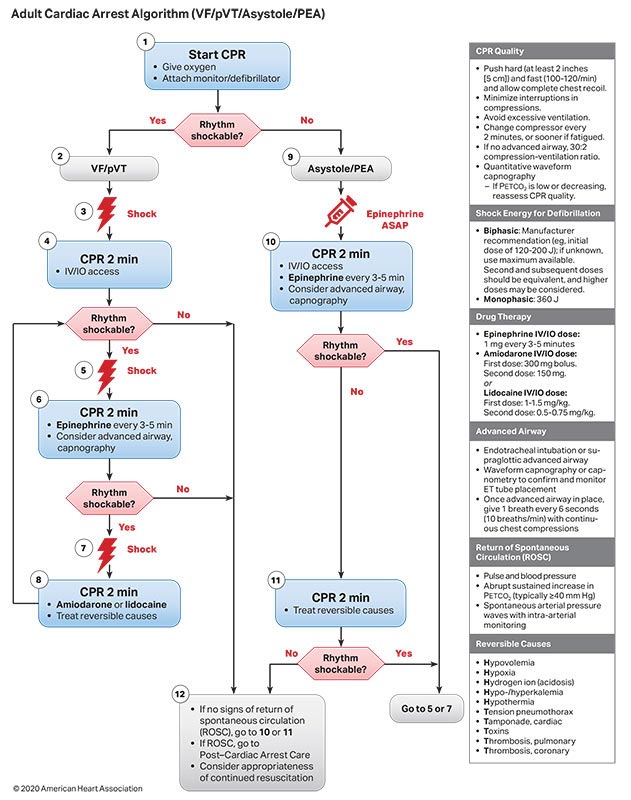
Which of the following best describes the correct administration of adrenaline for a shockable rhythm in adult advanced life support?
Your Answer: Give 1 mg of adrenaline after the second shock and every 3 - 5 minutes thereafter
Explanation:Give adrenaline 1 mg IV (IO) (10 mL of 1:10,000 solution) after the 2nd shock for adult patients in cardiac arrest with a shockable rhythm. Repeat adrenaline 1 mg IV (IO) every 3-5 minutes whilst ALS continues.
-
This question is part of the following fields:
- Cardiovascular
- Pharmacology
-
-
Question 16
Incorrect
-
In adult basic life support, chest compressions should be performed at which of the following rates:
Your Answer: 80 - 100 per minute
Correct Answer: 100 - 120 per minute
Explanation:Chest compressions should be performed at a rate of 100 – 120 per minute.
-
This question is part of the following fields:
- Cardiovascular
- Pharmacology
-
-
Question 17
Incorrect
-
What is the main mechanism of action of dopamine as an inotropic sympathomimetic:
Your Answer:
Correct Answer: Beta1-receptor agonist
Explanation:Dopamine is a neurotransmitter and a metabolic precursor of the catecholamines. It acts on beta1-receptors in cardiac muscle increasing cardiac contractility, and increases renal perfusion by stimulating dopamine receptors in the renal vasculature. This is of benefit in cardiogenic shock where deterioration of renal function is common.
-
This question is part of the following fields:
- Cardiovascular
- Pharmacology
-
-
Question 18
Incorrect
-
Discontinuous capillaries are typically found where in the body:
Your Answer:
Correct Answer: Reticuloendothelial system
Explanation:Discontinuous capillaries, found in the reticuloendothelial system (bone marrow, liver and spleen), have large gaps between endothelial cells and are permeable to red blood cells.
-
This question is part of the following fields:
- Cardiovascular
- Physiology
-
-
Question 19
Incorrect
-
In adult advanced life support, which of the following best describes the correct administration of adrenaline for a non-shockable rhythm:
Your Answer:
Correct Answer: Give 1 mg of adrenaline as soon as intravenous access is achieved and every 3 - 5 minutes thereafter
Explanation:IV adrenaline 1 mg (10 mL of 1:10,000 solution) should be given after 3 shocks and every 3 – 5 minutes/after alternate shocks thereafter.
-
This question is part of the following fields:
- Cardiovascular
- Pharmacology
-
-
Question 20
Incorrect
-
Arterial baroreceptors are located primarily in which of the following:
Your Answer:
Correct Answer: Carotid sinus and aortic arch
Explanation:Arterial baroreceptors are located in the carotid sinus and aortic arch, and detect the mean arterial pressure (MAP). A decrease in MAP (such as in postural hypotension, or haemorrhage) reduces arterial stretch and decreases baroreceptor activity, resulting in decreased firing in afferent nerves travelling via the glossopharyngeal nerve (carotid sinus) and vagus nerve (aortic arch) to the medulla where the activity of the autonomic nervous system is coordinated. Sympathetic nerve activity consequently increases, causing an increase in heart rate and cardiac contractility, peripheral vasoconstriction with an increase in TPR, and venoconstriction with an increase in CVP and thus an increase in cardiac output and blood pressure. Parasympathetic activity (vagal tone) decreases, contributing to the rise in heart rate.
-
This question is part of the following fields:
- Cardiovascular
- Physiology
-
-
Question 21
Incorrect
-
A patient has a cardiac output of 4.8 L/min and a heart rate of 80 bpm, therefore their stroke volume is:
Your Answer:
Correct Answer: 60 mL
Explanation:Cardiac output (CO) = Stroke volume (SV) x Heart rate (HR).
Therefore SV = CO/HR
= 4.8/80
= 0.06 L = 60 mL. -
This question is part of the following fields:
- Cardiovascular
- Physiology
-
-
Question 22
Incorrect
-
Regarding the cardiac cycle, which of the following statements is INCORRECT:
Your Answer:
Correct Answer: The second heart sound occurs in late diastole caused by closure of the atrioventricular valves.
Explanation:Diastole is usually twice the length of systole at rest, but decreases with increased heart rate. During systole, contraction of the ventricles compresses the coronary arteries and suppresses blood flow. This is particularly evident in the left ventricle, where during systole the ventricular pressure is the same as or greater than that in the arteries and as a result more than 85% of left ventricular perfusion occurs during diastole. This becomes a problem if the heart rate is increased as the diastolic interval is shorter and can result in ischaemia. The second heart sound, caused by closure of the semilunar valves, marks the end of systole.
-
This question is part of the following fields:
- Cardiovascular
- Physiology
-
-
Question 23
Incorrect
-
A 68-year-old man is being treated with digoxin for atrial fibrillation. When serum digoxin levels are above the therapeutic range, he is at highest risk for developing digoxin toxicity if he also develops which of the following?
Your Answer:
Correct Answer: Hypokalaemia
Explanation:Predisposing factors for digoxin toxicity include hypoxia, hypercalcaemia, hypokalaemia and hypomagnesaemia There should also be care taken in the elderly who are particularly susceptible to digoxin toxicity. Hypokalaemia may be precipitated by use of diuretics. Hyponatremia can result in the development of other pathological disturbances, but it does not make digoxin toxicity worse.
-
This question is part of the following fields:
- Cardiovascular
- Pharmacology
-
-
Question 24
Incorrect
-
In ventricular myocytes, the plateau phase of the action potential comes about through which of the following:
Your Answer:
Correct Answer: Opening of voltage-gated Ca 2+ channels
Explanation:After the intial upstroke of the action potential, Na+channels and currents rapidly inactivate, but in cardiac myocytes, the initial depolarisation activates voltage-gated Ca2+channels (slow L-type channels, threshold approximately – 45 mV) through which Ca2+floods into the cell. The resulting influx of Ca2+prevents the cell from repolarising and causes a plateau phase, that is maintained for about 250 ms until the L-type channels inactivate. The cardiac AP is thus much longer than that in nerve or skeletal muscle.
-
This question is part of the following fields:
- Cardiovascular
- Physiology
-
-
Question 25
Incorrect
-
If the ejection fraction increases, there will be a decrease in:
Your Answer:
Correct Answer: End-systolic volume
Explanation:An increase in ejection fraction means that a higher fraction of the end-diastolic volume is ejected in the stroke volume (e.g. because of the administration of a positive inotropic agent). When this situation occurs, the volume remaining in the ventricle after systole, the end-systolic volume, will be reduced. Cardiac output, stroke volume, and mean arterial pressure will be increased.
-
This question is part of the following fields:
- Cardiovascular
- Physiology
-
-
Question 26
Incorrect
-
All of the statements regarding vascular tone are correct except:
Your Answer:
Correct Answer: Most endogenous vasodilators act by decreasing levels of cAMP or cGMP.
Explanation:Most vasoconstrictors bind to G-protein coupled receptors. These mediate elevation in intracellular [Ca2+] which leads to vascular smooth muscle contraction. Important vasoconstrictors include noradrenaline, endothelin-1 and angiotensin II.
Increased intracellular Ca2+ is as a result of the release of Ca2+from the sarcoplasmic reticulum and depolarisation and entry of Ca2+via L-type voltage-gated Ca2+channels. Most types of vascular smooth muscle do not generate action potentials – instead, the depolarisation is graded, which allows graded entry of Ca2+.
sequestration by the sarcoplasmic reticulum Ca2+ATPase, removal from the cell by a plasma membrane Ca2+ATPase and Na+/Ca2+exchange decreases intracellular Ca2+, resulting in vasodilation. Relaxation is a result of most endogenous vasodilators when there is an increase in cyclic guanosine monophosphate (cGMP) like nitric oxide) or cyclic adenosine monophosphate (cAMP) like prostacyclin and beta-adrenergic receptor agonists. These activate protein kinases causing substrate level phosphorylation.
Clinically effective vasodilators are L-type Ca2+channel blocker drugs. -
This question is part of the following fields:
- Cardiovascular
- Physiology
-
-
Question 27
Incorrect
-
Adenosine has a half-life of approximately:
Your Answer:
Correct Answer: 8 - 10 seconds
Explanation:Adenosine stimulates A1-adenosine receptors and opens acetylcholine sensitive K+ channels, increasing K+ efflux. This hyperpolarises the cell membrane in the atrioventricular node and, by inhibiting the calcium channels, slows conduction in the AVN. As it has a very short duration of action (half-life only about 8 – 10 seconds), most side effects are short lived.
-
This question is part of the following fields:
- Cardiovascular
- Pharmacology
-
-
Question 28
Incorrect
-
Which of the following is NOT a typical side effect of digoxin:
Your Answer:
Correct Answer: Hypokalaemia
Explanation:Digoxin does not cause hypokalaemia, but hypokalaemia does potentiate digoxin toxicity. The adverse effects of digoxin are frequently due to its narrow therapeutic window and include:
Cardiac adverse effects – Sinoatrial and atrioventricular block, Premature ventricular contractions, PR prolongation and ST-segment depression
Nausea, vomiting and diarrhoea
Blurred or yellow vision
CNS effects – weakness, dizziness, confusion, apathy, malaise, headache, depression, psychosis
Thrombocytopenia and agranulocytosis (rare)
Gynaecomastia in men in prolonged administration -
This question is part of the following fields:
- Cardiovascular
- Pharmacology
-
-
Question 29
Incorrect
-
Nifedipine commonly causes which of the following adverse effects?
Your Answer:
Correct Answer: Ankle oedema
Explanation:Most common adverse effects of Nifedipine include:
Peripheral oedema (10-30%)
Dizziness (23-27%)
Flushing (23-27%)
Headache (10-23%)
Heartburn (11%)
Nausea (11%) -
This question is part of the following fields:
- Cardiovascular
- Pharmacology
-
-
Question 30
Incorrect
-
You are teaching a group of medical students about cardiovascular examination. You are discussing heart sounds and the cardiac cycle. Which of the following stages of the cardiac cycle occurs immediately after the aortic valve closes:
Your Answer:
Correct Answer: Isovolumetric relaxation
Explanation:Immediately after the closure of the semilunar valves, the ventricles rapidly relax and ventricular pressure decreases rapidly but the AV valves remain closed as initially the ventricular pressure is still greater than atrial pressure. This is isovolumetric relaxation. Atrial pressure continues to rise because of venous return, with the v wave of the JVP waveform peaking during this phase. Rapid flow of blood from the atria into the ventricles during the ventricular filling phase causes thethird heart sound, which is normal in children but, in adults, is associated with disease such as ventricular dilation.
-
This question is part of the following fields:
- Cardiovascular
- Physiology
-
SESSION STATS - PERFORMANCE PER SPECIALTY
