-
Question 1
Correct
-
You are teaching a group of medical students about cardiovascular examination. You are discussing heart sounds and the cardiac cycle. Which of the following stages of the cardiac cycle occurs immediately after the aortic valve closes:
Your Answer: Isovolumetric relaxation
Explanation:Immediately after the closure of the semilunar valves, the ventricles rapidly relax and ventricular pressure decreases rapidly but the AV valves remain closed as initially the ventricular pressure is still greater than atrial pressure. This is isovolumetric relaxation. Atrial pressure continues to rise because of venous return, with the v wave of the JVP waveform peaking during this phase. Rapid flow of blood from the atria into the ventricles during the ventricular filling phase causes thethird heart sound, which is normal in children but, in adults, is associated with disease such as ventricular dilation.
-
This question is part of the following fields:
- Cardiovascular
- Physiology
-
-
Question 2
Correct
-
Question 3
Correct
-
Fenestrated capillaries are typically found where in the body:
Your Answer: Renal glomeruli
Explanation:Fenestrated capillaries, found in renal glomeruli, endocrine glands and intestinal villi, are more permeable than continuous capillaries with less tight junctions, and the endothelial cells are also punctured by pores which allow large amounts of fluids or metabolites to pass.
-
This question is part of the following fields:
- Cardiovascular
- Physiology
-
-
Question 4
Correct
-
What is nimodipine used predominantly in the treatment of?
Your Answer: Prevention and treatment of vascular spasm following subarachnoid haemorrhage
Explanation:Nimodipine is a smooth muscle relaxant that is related to nifedipine, but the effects preferentially act on cerebral arteries. It is exclusively used for the prevention and treatment of vascular spasm after an aneurysmal subarachnoid haemorrhage.
-
This question is part of the following fields:
- Cardiovascular
- Pharmacology
-
-
Question 5
Correct
-
Regarding endothelin-1, which of the following statements is INCORRECT:
Your Answer: Endothelin-1 release is inhibited by noradrenaline.
Explanation:Endothelin-1 (ET-1) is an extremely potent vasoconstrictor peptide which is released from the endothelium in the presence of many other vasoconstrictors, including angiotensin II, antidiuretic hormone (ADH) and noradrenaline, and may be increased in disease and hypoxia.
-
This question is part of the following fields:
- Cardiovascular
- Physiology
-
-
Question 6
Correct
-
Blood flows from the left atrium into the left ventricle via:
Your Answer: The mitral valve
Explanation:Blood flows from the right atrium into the right ventricle via the tricuspid atrioventricular valve and from the left atrium into the left ventricle via the mitral atrioventricular valve. Blood is ejected from the right ventricle through the pulmonary semilunar valve into the pulmonary artery and from the left ventricle via the aortic semilunar valve into the aorta.
-
This question is part of the following fields:
- Cardiovascular
- Physiology
-
-
Question 7
Correct
-
The QRS duration of a broad-complex tachyarrhythmia is:
Your Answer: Greater than or equal to 0.12 s
Explanation:It’s a broad-complex tachycardia if the QRS duration is 0.12 seconds or more. It’s a narrow-complex tachycardia if the QRS complex is shorter than 0.12 seconds. The QRS duration should be examined if the patient with tachyarrhythmia is stable.
-
This question is part of the following fields:
- Cardiovascular
- Pharmacology
-
-
Question 8
Correct
-
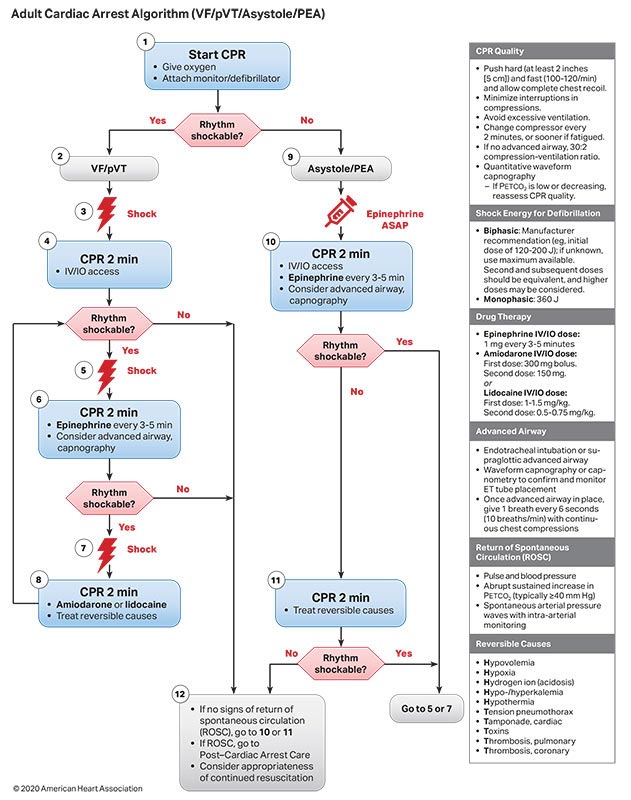
Which of the following best describes the correct administration of adrenaline for a shockable rhythm in adult advanced life support?
Your Answer: Give 1 mg of adrenaline after the second shock and every 3 - 5 minutes thereafter
Explanation:Give adrenaline 1 mg IV (IO) (10 mL of 1:10,000 solution) after the 2nd shock for adult patients in cardiac arrest with a shockable rhythm. Repeat adrenaline 1 mg IV (IO) every 3-5 minutes whilst ALS continues.
-
This question is part of the following fields:
- Cardiovascular
- Pharmacology
-
-
Question 9
Correct
-
An 82 year old man taking warfarin as a maintenance medication comes in to your clinic because of an infection. Which antibiotic is the safest choice for this patient?
Your Answer: Cefalexin
Explanation:Alterations in the international normalized ratio (INR) brought about by the concurrent use of antibiotics and warfarin may result in either excessive clotting or excessive bleeding if they are deemed to have a high risk for interaction. As such, there should be careful consideration of the class of antibiotic to be used.
Antibiotics from the following drug classes should generally be avoided as they have a high risk for interaction with warfarin, possible enhancing the anticoagulant effects of warfarin resulting in bleeding: Fluoroquinolones (e.g. ciprofloxacin, levofloxacin), Macrolides (e.g. clarithromycin, erythromycin, azithromycin), Nitroimidazoles (e.g. metronidazole), Sulphonamides (e.g. co-trimoxazole, a combination of trimethoprim and sulfamethoxazole), Trimethoprim, Tetracyclines (e.g. doxycycline).
Low risk antibiotics that have low risk for interaction with warfarin includes cephalexin, from the cephalosporin class, and clindamycin which is a lincomycin.
-
This question is part of the following fields:
- Cardiovascular
- Pharmacology
-
-
Question 10
Correct
-
Intracellular [Ca2+] rise in cardiac excitation-contraction coupling is mainly as a result of:
Your Answer: Ca 2+ release from sarcoplasmic reticulum
Explanation:Although Ca2+entry during the action potential (AP) is essential for contraction, it only accounts for about 25% of the rise in intracellular Ca2+. The rest is released from Ca2+stores in the sarcoplasmic reticulum (SR). APs travel down invaginations of the sarcolemma called T-tubules, which are close to, but do not touch, the terminal cisternae of the SR. During the AP plateau, Ca2+enters the cell and activates Ca2+sensitive Ca2+release channels in the sarcoplasmic reticulum allowing stored Ca2+to flood into the cytosol; this is called Ca2+-induced Ca2+release. The amount of Ca2+released is dependent on how much is stored, and on the size of the initial Ca2+influx during the AP.
-
This question is part of the following fields:
- Cardiovascular
- Physiology
-
SESSION STATS - PERFORMANCE PER SPECIALTY
