-
Question 1
Incorrect
-
A 32 year old women who is 25 weeks pregnant presents with vaginal bleeding and cramping lower abdominal pain. On examination the cervix is closed. Fetal cardiac activity is noted on ultrasound. What is the likely diagnosis?
Your Answer: Threatened Miscarriage
Correct Answer: Antepartum Haemorrhage
Explanation:Antepartum haemorrhage is any bleeding that occurs from the female genital tract during the antenatal period after the 24+0 week of pregnancy and prior to the birth of the baby. The most common causes are placenta previa and placental abruption.
-
This question is part of the following fields:
- Clinical Management
-
-
Question 2
Correct
-
A 34 week pregnant patient complains of itching over the past 6 weeks particularly to the hands and feet which is worse at night. You order some blood tests. Which of the following would you normally expect to increase in the 3rd trimester?
Your Answer: ALP
Explanation:Pruritus of pregnancy is a common disorder, which occurs in 1 in 300 pregnancies, and presents as excoriated papules on extensor limbs, abdomen
and shoulders. It is more common in women with a history of atopy. Prurigo usually starts at around 25–30 weeks of pregnancy and resolves after delivery,
with no effect on the mother or baby. Treatment is symptomatic with topical steroids and emollients. It occurs due to derangement in the LFTs. ALP can rise to up to 3 times the normal non-pregnant value in the 3rd trimester.
All of the other tests above typically decrease during pregnancy. -
This question is part of the following fields:
- Clinical Management
-
-
Question 3
Correct
-
Question 4
Incorrect
-
The amniotic fluid volume progressively increases during pregnancy. At which of the following gestational ages will amniotic fluid volume reach a maximum?
Your Answer: 32 weeks
Correct Answer: 35 weeks
Explanation:Amniotic fluid volume begins to increase rapidly in the second and third trimester as the fetal kidneys continue to develop. By 35 weeks gestation the amniotic fluid volume reaches a maximum average of about 800 ml after which it decreases slightly to term.
-
This question is part of the following fields:
- Clinical Management
-
-
Question 5
Incorrect
-
Which of the following ultrasound findings form part of the Rotterdam criteria for diagnosis of PCOS (Polycystic Ovary Syndrome) ?
Your Answer: 10 or more peripheral ovarian follicles
Correct Answer: Increased ovarian volume >10cm3
Explanation:The Rotterdam criteria for the diagnosis of PCOS is based on a score of two out of the three criteria:
1) Oligo or anovulation
2) Hyperandrogenism – clinical (hirsutism or less commonly male pattern alopecia) or biochemical (raised FAI or free testosterone)
3) on ultrasound – contain 12 or more follicles measuring 2 to 9 mm in diameter and/or have an increased volume of 10 cm3 or greater. -
This question is part of the following fields:
- Clinical Management
-
-
Question 6
Correct
-
Which of the following is the most appropriate for diagnosis of Bacterial Vaginosis (BV)?
Your Answer: Amsel's criteria
Explanation:Diagnosis can be made using the Amsel’s criteria:
1. Presence of clue cells on microscopic examination (these cells are epithelial cells covered with the bacteria).
2. Creamy greyish discharge.
3. Vaginal pH of more than 4.5.
5. Positive whiff test – release of fishy odour on addition of alkali solution. Other criteria include the nugent score and the Hay/Ison criteria. The Nugent score estimates the relative proportions of bacterial morphotypes to give a score between 0 and 10 (<4 = normal, 4-6 = intermediate, >6 = BV)
The Hay/Ison criteria
Grade 1 (Normal): Lactobacillus morphotypes predominate
Grade 2 (Intermediate): Mixed flora with some Lactobacilli present, but Gardnerella or Mobiluncus morphotypes also present
Grade 3 (BV): Predominantly Gardnerella and/or Mobiluncus morphotypes. Few or absent Lactobacilli. -
This question is part of the following fields:
- Clinical Management
-
-
Question 7
Correct
-
A 24 year old lady is 9 weeks pregnant with her first child. She attends clinic complaining of severe vomiting and is unable to keep fluids down. The most likely diagnosis is hyperemesis gravidarum. Which of the following is the underlying cause?
Your Answer: Increased circulating HCG
Explanation:Hyperemesis gravidarum (HG) is a severe form of nausea and vomiting in pregnancy, associated with weight loss of more than 5% of pre-pregnancy weight, dehydration and electrolyte imbalance. HG is usually most severe during the first 12 weeks of pregnancy and is thought to be caused by high circulating levels of HCG.
There is not yet any evidence that pregnancy itself increases the sensitivity of the area postrema, or that the hormones, oestradiol, or progesterone increase vomiting. Generally, higher concentrations of dopamine stimulates receptors in the chemoreceptor trigger zone leading to nausea and vomiting. Although this has not been demonstrated as the cause of hyperemesis gravidarum.
-
This question is part of the following fields:
- Clinical Management
-
-
Question 8
Correct
-
Breast feeding stimulates the hypothalamus to produce which of the following hormones?
Your Answer: Oxytocin
Explanation:Breast feeding facilitates the production of Oxytocin by the hypothalamus which is stored and secreted by the posterior pituitary.
Ergometrine is an ergoline derivative that can be used to increase uterine tone.
Atosiban is an antagonist of Oxytocin receptors
ADH is another posterior pituitary hormone.
Prostaglandin E2 plays an important role in cervical ripening. -
This question is part of the following fields:
- Clinical Management
-
-
Question 9
Correct
-
You receive a swab result from a patient who had complained of odorous vaginal discharge. It confirms bacterial vaginosis (BV). Which pathogen is most commonly associated with BV?
Your Answer: Gardnerella vaginalis
Explanation:BV typically presents as an increase in vaginal discharge and vaginal malodour caused by a change in vaginal bacterial flora. PV discharge due to BV is typically grey fluid that adheres to the vaginal mucosa. BV is a polymicrobial infection. Gardnerella is the most commonly associated pathogen. Other associated bacteria include Lactobacillus species, Prevotella, Mobiluncus, Bacteroides, Peptostreptococcus, Fusobacterium, Veillonella, Eubacterium species, Mycoplasma hominis, Urea plasma urealyticum and Streptococcus viridans.
-
This question is part of the following fields:
- Clinical Management
-
-
Question 10
Incorrect
-
A patient has had limited response to conservative measures for her overactive bladder (OAB). Which of the following is the most appropriate pharmacological choice?
Your Answer: Desmopressin
Correct Answer: Darifenacin
Explanation:Detrusor overactivity can be treated with anti-cholinergic agents such as oxybutynin or tolterodine, solifenacin, fesoterodine and darifenacin. They are used as first line agents. Imipramine is used for enuresis and desmopressin is used for nocturia.
NICE pathwayPrior to initiating anticholinergics:
Bladder training
Consider treating vaginal atrophy and nocturia with topical oestrogen and desmopressin respectively before commencing treatments below.
Consider catheterisation if chronic retention
1st line treatments:
1. Oxybutynin (immediate release) – Do not offer to frail elderly patients
2. Tolterodine (immediate release)
3. Darifenacin (once daily preparation)
DO NOT offer any of the 3 drugs below:
1. Flavoxate
2. Propantheline
3. Imipramine
2nd line treatment
Consider transdermal anticholinergic (antimuscarinic)
Mirabegron
Adjuvant Treatments
Desmopressin can be considered for those with nocturia
Duloxetine may be considered for those who don’t want/unsuitable for surgical treatment
Intravaginal oestrogen can be offered to postmenopausal women with OAB -
This question is part of the following fields:
- Clinical Management
-
-
Question 11
Correct
-
A 26 year old patient sustains a 4th degree perineal tear following delivery of her 1st baby. Your consultant agrees to supervise you repair the tear. From the list below what is the most appropriate suture option for repairing the anal mucosa?
Your Answer: 3-0 polyglactin interrupted sutures
Explanation:Repair the vaginal mucosa using rapidly absorbed suture material on a large, round body needle. Start above the apex of the cut or tear (as severed vessels retract slightly) and use a continuous stitch to close the vaginal mucosa.
-
This question is part of the following fields:
- Clinical Management
-
-
Question 12
Incorrect
-
A patient at 15 weeks gestation undergoes an abortion. She has no known drug allergies. Which of the following is the most appropriate regarding antibiotic prophylaxis?
Your Answer:
Correct Answer: Stat Azithromycin 1g and metronidazole 800 mg orally at time of abortion
Explanation:First trimester abortions are performed using mifepristone 600 mg followed by insertion of 1 mg gemeprost vaginal pessary. The patients stays in the hospital for about 4-6 hours. At the time of abortion azithromycin 1 g and metronidazole 800 mg should be given to cover the gram positive and negative bacteria.
-
This question is part of the following fields:
- Clinical Management
-
-
Question 13
Incorrect
-
According to the RCOG Green-top guidelines on prevention and management of post-partum haemorrhage (PPH) which of the following statements is true?
Your Answer:
Correct Answer: For women delivering by caesarean section, Oxytocin 5 iu by slow IV injection should be used
Explanation:Misoprostol is not as effective as oxytocin but may be used if Oxytocin is not available e.g. home birth Recommended doses of Oxytocin For vaginal deliveries: 5 iu or 10 iu by intramuscular injection. For C-section: 5 iu by IV injection
-
This question is part of the following fields:
- Clinical Management
-
-
Question 14
Incorrect
-
A 30 year old women who is 24 weeks pregnant attends EPU due to suprapubic pain. Ultrasound shows a viable foetus and also a fibroid with a cystic fluid filled centre. What is the likely diagnosis?
Your Answer:
Correct Answer: Red degeneration of fibroid
Explanation:Red degeneration of fibroids is one of 4 methods of fibroid degeneration. Although uncommon outside pregnancy it is thought to be the most common form of fibroid degeneration during pregnancy and typically occurs in the 2nd trimester. It is thought to arise from the fibroid outgrowing its blood supply and haemorrhagic infarction occurs. Ultrasound will typically show a localised fluid collection (blood) within the fibroid.
-
This question is part of the following fields:
- Clinical Management
-
-
Question 15
Incorrect
-
Completion of the 3rd stage of labour refers to:
Your Answer:
Correct Answer: Expulsion of the placenta and membranes
Explanation:The third stage of labours starts from the delivery of the foetus to the delivery of the placenta and the membranes.
-
This question is part of the following fields:
- Clinical Management
-
-
Question 16
Incorrect
-
A 24 year old who is 32 weeks pregnant presents with a rash to the abdomen. Looking at the picture below what is the diagnosis?
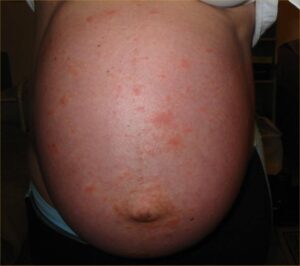
Your Answer:
Correct Answer: Polymorphic Eruption of Pregnancy
Explanation:This is Polymorphic Eruption of Pregnancy (PEP) also known as Pruritic Urticarial Papules and Plaques of Pregnancy (PUPPP). Papules and plaques form on the abdomen (commonly within striae). It is most common in women during their first pregnancy and typically occurs in the 3rd trimester.
-
This question is part of the following fields:
- Clinical Management
-
-
Question 17
Incorrect
-
Which of the following has been shown to improve pruritus and liver function in patients with obstetric cholestasis?
Your Answer:
Correct Answer: Ursodeoxycholic acid
Explanation:Intrahepatic cholestasis characterized by reversible cholestasis typically occurring in the second or third trimester of pregnancy, elevated serum aminotransferases and bile acid level and resolution of symptoms by 2 to 3 weeks after delivery. Ursodeoxycholic acid has shown to reduce the symptoms of this condition.
-
This question is part of the following fields:
- Clinical Management
-
-
Question 18
Incorrect
-
A 26 year old patient attends the maternity unit as her waters have broken but she hasn't had contractions. She is at 39+5 weeks gestation. Speculum examination confirms prelabour rupture of membranes (PROM). What is the risk of serious neonatal infection with PROM?
Your Answer:
Correct Answer: 1 in 100
Explanation:In pregnancy, term refers to the gestational period from 37 to 41+6 weeks. Preterm births occur between 24 and 36+6 weeks. Only 1% of women who go into PROM have risk of having serious neonatal infections.
Management of PROM:
60% of patients with PROM will go into labour within 24 hrs
Induction is appropriate if >34 weeks gestation and more than 24 hours post rupture when labour hasn’t started.
If < 34 weeks, induction of labour should not be carried out unless there are additional obstetric indications e.g. infection -
This question is part of the following fields:
- Clinical Management
-
-
Question 19
Incorrect
-
You are called to see a 24 year old patient in A&E. She is 34 weeks gestation and her blood pressure is 149/98. Urine dip shows protein 3+. You send a for a protein:creatinine ratio. What level would be diagnostic of significant proteinuria?
Your Answer:
Correct Answer: >30 mg/mmol
Explanation:Significant proteinuria = urinary protein:creatinine ratio >30 mg/mmol or 24-hour urine collection result shows greater than 300 mg protein
-
This question is part of the following fields:
- Clinical Management
-
-
Question 20
Incorrect
-
A 28 year old patient has a diagnosis of PCOS. She has been trying to conceive for 2 years. Her BMI is 26 kg/m2 and she is a non-smoker. She has been taking Clomiphene and metformin for the past 6 months. What is the next most appropriate treatment?
Your Answer:
Correct Answer: Gonadotrophins
Explanation:Management of PCOS includes OCP, cyclical oral progesterone, metformin, clomiphene (which is more effective in inducing ovulation than metformin) and life-style changes. In women who are tolerant to these therapies Gonadotrophins should be trialled. However lifestyle changes should be able to improve the condition significantly. Clomiphene shouldn’t be continued for more than 6 months.
-
This question is part of the following fields:
- Clinical Management
-
-
Question 21
Incorrect
-
A 45 year old women is seen in clinic following hysteroscopy and biopsy due to irregular menstrual bleeding. Her BMI is 34 kg/m2. This shows atypical hyperplasia. Which of the following is the most appropriate 1st line management?
Your Answer:
Correct Answer: Laparoscopic hysterectomy
Explanation:Endometrial hyperplasia with atypia is at high risk of progression to cancer and hysterectomy is indicated There is high risk of progression to cancer with endometrial hyperplasia with atypia and hysterectomy is indicated. Although weight loss would be beneficial this shouldn’t delay surgical management.
-
This question is part of the following fields:
- Clinical Management
-
-
Question 22
Incorrect
-
A patient undergoes medical abortion at 9 weeks gestation. What is the advice regarding Rhesus Anti-D Immunoglobulin?
Your Answer:
Correct Answer: All RhD-negative women who are not alloimmunized should receive Anti-D IgG
Explanation:All non-sensitised RhD negative women should receive Anti-D IgG within 72 hours following abortion
-
This question is part of the following fields:
- Clinical Management
-
-
Question 23
Incorrect
-
A 53 year old lady presents to clinic due to vulval itch and discolouration. examination reveals pale white discoloured areas to the vulva. A biopsy shows epidermal atrophy with sub-epidermal hyalinization and deeper inflammatory infiltrate. What is this characteristic of?
Your Answer:
Correct Answer: Lichen Sclerosus
Explanation:Lichen sclerosus is characterized by hypopigmented atrophic plaque in the perineal region along with features of pruritis and dyspareunia.
It is more common in post menopausal women and on histology there is epidermal atrophy, inflammatory infiltrate in the dermis and basal layer degeneration.Vitiligo is characterised by hypopigmentation but without any other symptoms.
Extramammary Paget’s disease is characterized by erythematous plaque located mostly in the perianal region but its histology is different.
Lichen simplex chronicus is a chronic scaly pruritic condition characterized by itchy papules and plaques plus lichenification and it mostly results from chronic irritation and itching of the area. -
This question is part of the following fields:
- Clinical Management
-
-
Question 24
Incorrect
-
A 26 year old women presents for her 12 week scan. She has been pregnant once before but had a 1st trimester miscarriage. She reports no problems with this pregnancy and has had no vaginal bleeding or spotting. The scan shows no fetal cardiac activity and a small gestational sac. What is the likely diagnosis?
Your Answer:
Correct Answer: Missed Miscarriage
Explanation:As there has been no bleeding or expulsion of the products of conception this is a missed miscarriage
-
This question is part of the following fields:
- Clinical Management
-
-
Question 25
Incorrect
-
What is the mode of action of Tranexamic acid?
Your Answer:
Correct Answer: Inhibits Plasminogen Activation
Explanation:Tranexamic acid is an antifibrinolytic drug which is one of the treatment options in menorrhagia i.e. heavy menstrual bleeding. It acts by binding to the receptor sites on plasminogen thus preventing plasmin from attaching to those receptors thus inhibiting plasminogen activation.
If pharmaceutical treatment is appropriate NICE advise treatments should be considered in the following order:
1. levonorgestrel-releasing intrauterine system (LNG-IUS) provided at least 12 months use is anticipated
2. tranexamic acid or NSAIDs* or combined oral contraceptives (COCs) or cyclical oral progestogens
3. Consider progesterone only contraception e.g. injected long-acting progestogens*When heavy menstrual bleeding (HMB) coexists with dysmenorrhoea NSAIDs should be preferred to tranexamic acid. Also note NSAIDs and tranexamic are appropriate to use if treatment needed pending investigations.
-
This question is part of the following fields:
- Clinical Management
-
-
Question 26
Incorrect
-
Which of the following dugs is a strong inducer of cytochrome P450?
Your Answer:
Correct Answer: Phenytoin
Explanation:It is important to be aware of which ant-epileptics induce cytochrome P450. Of the above Topiramate and Phenytoin are moderate and strong inducers respectively.
-
This question is part of the following fields:
- Clinical Management
-
-
Question 27
Incorrect
-
Question 28
Incorrect
-
How long does involution of the uterus take after parturition?
Your Answer:
Correct Answer: 4-6 weeks
Explanation:In the period immediately after the delivery of the placenta, known as the puerperium, the female reproductive system begins to undergo some physiological changes to return to a non-pregnant state. One of these changes is uterine involution. The myometrium contracts, constricting blood vessels which impedes blood flow. It is thought that the uterine tissues then undergo apoptosis and autophagy. It takes about 4-6 weeks for the uterus to decrease is size from about 1 kg to 60 grams.
-
This question is part of the following fields:
- Clinical Management
-
-
Question 29
Incorrect
-
Your consultant agrees to supervise you performing a Caesarean Section (CS). When making a Joel Cohen incision where should this be placed?
Your Answer:
Correct Answer: 3 cm above the symphysis pubis
Explanation:The Joel Cohen incision is superior to the Pffannenstiel incision. It is a straight incision that is 3 cm below the line joining the anterior iliac spines.
-
This question is part of the following fields:
- Clinical Management
-
-
Question 30
Incorrect
-
Which species of candida is the most common cause of genital candida infection in pregnancy?
Your Answer:
Correct Answer: Candida albicans
Explanation:Vulvovaginal candidiasis is the most common genital infection and it is caused by candida albicans in 80-92% of the cases. Other non albicans species include C.tropicalis, C.glabrata, C.krusei and C.parapsilosis. 20% of women of childbearing age are asymptotic colonisers of Candida species as part of their normal vaginal flora. This increases to 40% in pregnancy.
-
This question is part of the following fields:
- Clinical Management
-
SESSION STATS - PERFORMANCE PER SPECIALTY
