-
Question 1
Incorrect
-
Renal cell carcinoma is associated with which type of metastasis?
Your Answer: Lymphatic
Correct Answer: Haematogenous
Explanation:Most carcinomas spread primarily via lymphatic invasion. Renal cell is the exception spreading via the bloodstream.
-
This question is part of the following fields:
- Clinical Management
-
-
Question 2
Incorrect
-
A 67 year old patient with endometrial carcinoma is to undergo staging investigations. There is evidence of invasion into the vaginal wall, but the lymph nodes are spared, and there is no distant metastasis. According to FIGO, what stage is this?
Your Answer: 2
Correct Answer: 3B
Explanation:Endometrial cancer is one of the most common gynaecological malignancies present in postmenopausal women, with a peak incidence between the ages of 60-89. Factors associated with endometrial cancer include obesity, hypertension and diabetes. Full staging for endometrial cancer is surgical, including several other radiologic investigations. According to FIGO staging classifications:
Stage 1 indicates a tumour confined to the uterine body
Stage 2 indicates the invasion of the cervical stroma
Stage 3 indicates local and regional spread, where the tumour invades the serosa in stage 3A, spreads to the vagina and parametrium in stage 3B, and metastasizes to the pelvic or para-aortic lymph nodes in stage 3C.
Stage 4 indicates tumour invasion on the bladder or bowel mucosa, or distant metastasis. -
This question is part of the following fields:
- Clinical Management
-
-
Question 3
Correct
-
Endometrial tissue found within the myometrium is classed as:
Your Answer: Adenomyosis
Explanation:Adenomyosis is a disorder characterised by the presence of endometrial glands deep within the myometrium. It presents with increasing severe secondary dysmenorrhoea and increased in the flow of menstrual blood.
-
This question is part of the following fields:
- Clinical Management
-
-
Question 4
Correct
-
Question 5
Incorrect
-
A 25 year old prim gravida carrying a twin male pregnancy presents at 31 weeks gestation. She is lethargic, clinically jaundiced and complains of abdominal pain with frequent vomiting. You suspect acute fatty liver of pregnancy (AFLP). What is the maternal mortality rate with AFLP?
Your Answer: 5%
Correct Answer: 20%
Explanation:Acute fatty liver of pregnancy occurs in 1-10000 pregnancies and presents as jaundice with abdominal pain. The maternal mortality is around 20%
-
This question is part of the following fields:
- Clinical Management
-
-
Question 6
Incorrect
-
Regarding pelvic Gonorrhoea infection in women. What percentage of cases are asymptomatic?
Your Answer: 15%
Correct Answer: 50%
Explanation:Gonorrhoea is a sexually transmitted disease that is caused by Neisseria gonorrhoea. It infects the mucous membrane of the genital tract epithelium in the endocervical and the urethral mucosa. Around 50% of the women are asymptomatic. However it presents as increase vaginal discharge, dysuria, proctitis and pelvic tenderness.
-
This question is part of the following fields:
- Clinical Management
-
-
Question 7
Incorrect
-
Regarding uterine fibroids, which of the following statements is false?
Your Answer: The prevalence of fibroids is higher in black women than white women
Correct Answer: The risk of fibroids is increased by pregnancy
Explanation:Fibroids are a common gynaecological condition found in many women above the age of 35. They are however uncommon before puberty. They are most common in black women vs white women, and its prevalence increases from puberty to menopause. Risk factors for fibroids include increasing age, obesity and infertility. Protective factors, on the other hand, include pregnancy, as the risk of fibroids decreases with increasing numbers of pregnancies.
-
This question is part of the following fields:
- Clinical Management
-
-
Question 8
Correct
-
A patient undergoes medical abortion at 9 weeks gestation. What is the advice regarding Rhesus Anti-D Immunoglobulin?
Your Answer: All RhD-negative women who are not alloimmunized should receive Anti-D IgG
Explanation:All non-sensitised RhD negative women should receive Anti-D IgG within 72 hours following abortion
-
This question is part of the following fields:
- Clinical Management
-
-
Question 9
Incorrect
-
What percentage of infants will have permanent neurological dysfunction as a result of brachial plexus injury secondary to shoulder dystocia?
Your Answer: 35%
Correct Answer:
Explanation:Shoulder dystocia occurs when the anterior or posterior fetal shoulder impacts on the maternal symphysis or sacrum and may require additional manevours to release the shoulders after gentle downward traction has failed. The most common injury that can occur, is to the brachial plexus due to lateral flexion of the head during traction. This may cause a neurological disability, Erb’s Palsy ( injury to C5 and C6 of the brachial plexus) in which there is a less than 10% chance that this injury would be permanent.
-
This question is part of the following fields:
- Clinical Management
-
-
Question 10
Correct
-
Regarding anti-epileptic use in the 1st trimester of pregnancy, which of the following is closely associated with the development of congenital malformations?
Your Answer: Sodium valproate
Explanation:Sodium Valproate is known to be the most teratogenic when used in the first trimester of pregnancy. This antiepileptic increases the risk of congenital malformations including a 10-20 fold risk of neurodevelopmental defects. Though the use of antiepileptics should generally be avoided during pregnancy, carbamazepine, or newer drugs such as Lamotrigine are thought to carry less of a risk of teratogenicity.
-
This question is part of the following fields:
- Clinical Management
-
-
Question 11
Incorrect
-
Which of the following drugs is most associated with coronary artery spasm?
Your Answer: Verapamil
Correct Answer: Ergometrine
Explanation:Ergot alkaloids e.g. Ergometrine, produce marked and prolonged alpha receptor mediated vasoconstriction. Its overdose can cause ischemia and gangrene of the limbs and bowel. It also causes coronary artery spasm and has been used by cardiologist as a provocation test.
-
This question is part of the following fields:
- Clinical Management
-
-
Question 12
Correct
-
Which of the following statements regarding management of obstetric anal sphincter injuries (OASIS) is true?
Your Answer: Broad-spectrum antibiotics should be given routinely following OASIS
Explanation:After perineal repair, lactulose and a bulking agent should ideally be given for 5-10 days as well as broad spectrum antibiotics should be given that will cover all possible anaerobic bacteria. At 6-12 months a full evaluation should be done regarding the progress of healing. 60 to 80% of women are asymptomatic 12 months post delivery and external anal sphincter repair.
-
This question is part of the following fields:
- Clinical Management
-
-
Question 13
Correct
-
A couple present to the fertility clinic after failing to conceive despite trying for 2.5 years. The semen analysis shows azoospermia. You perform a full examination of the male partner which reveals Height 192cm, BMI 20.5, small testes and scant facial hair. You decide to organise karyotyping. What is the result likely to show?
Your Answer: 47XXY
Explanation:Klinefelter syndrome is associated with testicular atrophy, eunuchoid body shape, tall, long extremities, female hair distribution and gynaecomastia. It is a common cause of hypogonadism seen during fertility workup.
-
This question is part of the following fields:
- Clinical Management
-
-
Question 14
Incorrect
-
According to the NICE guidelines on intrapartum care a multiparous women with intact membranes should be offered amniotomy if there is inadequate progress of the active second stage of labour (in terms of rotation and/or descent of the presenting part) after how long?
Your Answer: 90 minutes
Correct Answer: 30 minutes
Explanation:Multiparous women active 2nd stage labour: Suspect delay if progress inadequate after 30 minutes Diagnose delay if progress inadequate after 1 hour If delay is suspected amniotomy should be offered if membranes are intact If delay diagnosed then preparations should be made for C-section Nulliparous women active 2nd stage labour: Suspect delay if progress inadequate after 1 hour Diagnose delay if progress inadequate after 2 hours If delay is suspected amniotomy should be offered if membranes are intact If delay diagnosed then preparations should be made for C-section
-
This question is part of the following fields:
- Clinical Management
-
-
Question 15
Correct
-
What type of drug is clavulanic acid?
Your Answer: Beta-lactamase inhibitor
Explanation:Clavulanic acid is a beta-lactamase inhibitor that is most often combined with a penicillin to form Augmentin or Co-amoxiclav for greater antibiotic efficacy. The drug works by irreversibly binding to enzymes present in bacteria which posses the Beta-lactamase enzyme. This enzyme is responsible for inactivating Beta-Lactam antibiotics such as penicillin.
-
This question is part of the following fields:
- Clinical Management
-
-
Question 16
Correct
-
A 32 year old lady with known stage III cervical cancer presents to A&E with lower abdominal and unilateral flank pain. From the following list what is the likely diagnosis?
Your Answer: Ureteric Obstruction
Explanation:In stage III cervical cancer there is involvement of the pelvic wall and ureter which may result in abdominal pain and hydronephrosis.
2010 FIGO classification of cervical carcinoma
Stage
0 – Carcinoma in situ
1 – Confined to the cervix (diagnosed microscopy)
1A1 – Less than 3mm depth & 7mm lateral spread
1A2 – 3mm to 5mm depth & less than 7mm lateral spread
1B1 – Clinically visible lesion or greater than A2 & less than 4 cm in greatest dimension
1B2 – Clinically visible lesion, Greater than 4 cm in greatest dimension
2 – Invades beyond uterus but not to pelvic wall or lower 1/3 vagina
2A1 – Involvement of the upper two-thirds of the vagina, without parametrical invasion & Less than 4cm
2A2 – Greater than 4 cm in greatest dimension
2B – Parametrial involvement
3 – Extends to Pelvic side wall or lower 1/3 vagina or hydronephrosis
3A – No pelvic side wall involvement
3B – Pelvic side wall involved or hydronephrosis
4 – Extends beyond true pelvis
4A – Invades mucosa bladder and rectum
4B – Distant Metastasis -
This question is part of the following fields:
- Clinical Management
-
-
Question 17
Correct
-
You review a patient in the fertility clinic. The ultrasound and biochemical profile are consistent with PCOS. She has been trying to conceive for 2 years. Her BMI is 26 kg/m2. She is a non-smoker. You plan to initiate Clomiphene. According to NICE guidance how long should treatment continue for (assuming patient remains non-pregnant)?
Your Answer: 6 months
Explanation:Treatment with Clomiphene should not exceed 6 months.
-
This question is part of the following fields:
- Clinical Management
-
-
Question 18
Incorrect
-
What is the most common Type II congenital thrombophilia?
Your Answer: Antiphospholipid syndrome
Correct Answer: Factor V Leiden mutation
Explanation:Factor V Leiden is the most common congenital thrombophilia. Named after the Dutch city Leiden where it was first discovered. Protein C and S deficiencies are type 1 (Not type 2) thrombophilias Antiphospholipid syndrome is an acquired (NOT congenital) thrombophilia
-
This question is part of the following fields:
- Clinical Management
-
-
Question 19
Correct
-
A 28 year old women presents at 30 weeks complaining of intense itching particularly on the hands and feet that is worse in the evenings. She has taken cetirizine but this hasn't settled her symptoms. Examination is unremarkable with no rash. What is the likely diagnosis
Your Answer: Intrahepatic Cholestasis of Pregnancy
Explanation:The history is typical of Intrahepatic Cholestasis of Pregnancy, also known as obstetric cholestasis and prurigo gravidarum. The features are: Intense itching typically of the hands and feet Itch gets worse at night Responds poorly to antihistamines There is no rash. The mechanism is poorly understood but tests may show deranged LFTs. It usually resolves quickly after delivery. The other diagnoses listed are possible though less likely. Scabies normally has a rash
-
This question is part of the following fields:
- Clinical Management
-
-
Question 20
Correct
-
You are discussing a planned Caesarean Section (CS) with a patient. Which of the following risks is reduced with CS?
Your Answer: Early postpartum haemorrhage
Explanation:There are many different reasons for performing a delivery by Caesarean section. The four major indications accounting for greater than 70 per cent of operations are: 1. previous Caesarean section 2. dystocia 3. malpresentation 4. suspected acute fetal compromise. Other indications, such as multifetal pregnancy, abruptio placenta, placenta praevia, fetal disease and maternal disease are less common. The chances of early postpartum haemorrhage are greatly reduced in C-section deliveries.
-
This question is part of the following fields:
- Clinical Management
-
-
Question 21
Incorrect
-
Pregnant patients are at higher risk of thromboembolism due to a hypercoagulable state. Which of the following clotting factors reduces during pregnancy?
Your Answer: Fibrinogen
Correct Answer: Factor XI
Explanation:Pregnancy is a hypercoagulable state, which means that risk of thromboembolism is increased. The main reason is an increase in clotting factors II, factor VII, fibrinogen, factor X and factor XII, whereas factors XI and factor XIII are reduced. Naturally occurring anticoagulants i.e. protein C and protein S are both decreased thus increasing the risk of thrombus formation.
-
This question is part of the following fields:
- Clinical Management
-
-
Question 22
Incorrect
-
Which of the following dugs is a strong inducer of cytochrome P450?
Your Answer: Lamotrigine
Correct Answer: Phenytoin
Explanation:It is important to be aware of which ant-epileptics induce cytochrome P450. Of the above Topiramate and Phenytoin are moderate and strong inducers respectively.
-
This question is part of the following fields:
- Clinical Management
-
-
Question 23
Incorrect
-
What is the half life of Oxytocin?
Your Answer: 3 hours
Correct Answer: 5 minutes
Explanation:The half-life of Oxytocin is approximately 5 minutes
The half-life of Misoprostol is approximately 20-40 minutes
The half-life of Ergometrine is approximately 30-120 minutes -
This question is part of the following fields:
- Clinical Management
-
-
Question 24
Correct
-
Which of the following conditions is associated with blunt trauma in a pregnant woman?
Your Answer: Abruptio placentae
Explanation:Abruptio placentae, defined as a premature separation of the placenta from the uterine wall, is commonly seen with blunt abdominal trauma and can cause fetal distress. It occurs in 1% to 3% of pregnant women with minor trauma and in 40% to 50% with major life-threatening trauma.8,9 Abruption may present with vaginal bleeding, abdominal pain and tenderness, uterine contractions, or fetal distress; however, it may be occult with no vaginal bleeding in up to 20% of cases.
-
This question is part of the following fields:
- Clinical Management
-
-
Question 25
Correct
-
A 42 year old smoker attends clinic due to vulval soreness and shows you a number of vulval lumps. Biopsy is taken and reported as showing
Your Answer: Vulval intraepithelial neoplasia (VIN)
Explanation:This is VIN. Smoking is a risk factor. It is also more common in immunocompromised patients.
-
This question is part of the following fields:
- Clinical Management
-
-
Question 26
Incorrect
-
A 24 year old lady is rushed to the emergency department complaining of vaginal spotting and abdominal cramping. Her 6 week pregnancy was confirmed by ultrasound scan last week. On speculum examination, the cervical os is open with blood noted around it.
Which of the following is the most likely diagnosis?Your Answer: Threatened Miscarriage
Correct Answer: Inevitable Miscarriage
Explanation:A miscarriage is defined as the spontaneous loss of a pregnancy before the age of viability at 24 weeks in the UK. An inevitable miscarriage occurs with the usual symptoms of a miscarriage such as menstrual-like cramping, vaginal bleeding and a dilated cervix. The gestational sac has ruptured but products of conception have not been passed. The products of conception will eventually pass.
A missed miscarriage is described as a loss of pregnancy without vaginal bleeding, loss of tissue, cervical changes or abdominal pain. During a scan, a fetal heartbeat is not observed, and the gestational sac may be small.
A threatened miscarriage is when the cervix dilates and uterine bleeding is seen; the pregnancy could still be viable.
A complete miscarriage occurs when all the products of conception are expelled from the uterus, bleeding has stopped, and the cervix has closed up after dilation. Recurrent miscarriages are described as spontaneous pregnancy loss of more than 2 to 3 consecutive times.
-
This question is part of the following fields:
- Clinical Management
-
-
Question 27
Incorrect
-
In the 3rd trimester anaemia is defined by?
Your Answer: Haemoglobin < 110 g/l
Correct Answer:
Explanation:Anaemia in pregnancy is defined by the British Committee for Standards in Haematology (BCSH) guidance: 1st trimester Hb < 110 g/l 2nd and 3rd trimester Hb < 105 g/l Postpartum Hb less than 100 g/l
-
This question is part of the following fields:
- Clinical Management
-
-
Question 28
Incorrect
-
Which of the following contraceptives primary mode of action is inhibition of ovulation?
Your Answer: Norgeston®
Correct Answer: Cerazette®
Explanation:Traditional POP main mode of contraceptive action: thickening of cervical mucus Desogestrel-only POP main mode of contraceptive action is inhibition of ovulation Cerazette® is the only Desogestrel-only POP in the options above. Other desogestrel brands include: Aizea® Cerelle® Nacrez® The other POPs listed are considered traditional POPs and have the following compositions: Norgeston® – Levonorgestrel 30 mcg Micronor® & Noriday® – Norethisterone 350 mcg Femulen® – Ethynediol diacetate 500 mcg
-
This question is part of the following fields:
- Clinical Management
-
-
Question 29
Incorrect
-
Which of the following is associated with use of a tocolytic drug?
Your Answer: Prolongation of pregnancy for up to 72 hours
Correct Answer: Prolongation of pregnancy for up to 7 days
Explanation:The WHO recommends that tocolytics can safely be used to prolong pregnancy for up to seven days. The tocolytic drugs are used to suppress contractions to allow for more favourable conditions in the case of preterm labour, such as transfer to a better-equipped health care facility with a neonatal intensive care unit, or for those who have not yet completed a full dose of corticosteroids. It is not however associated with better neonatal outcomes in the imminent delivery of preterms. Examples of tocolytics include calcium channel blockers, magnesium sulphate, and oxytocin antagonists.
-
This question is part of the following fields:
- Clinical Management
-
-
Question 30
Incorrect
-
What is the average volume of blood loss during the menstrual cycle?
Your Answer: 80-85ml
Correct Answer: 35-40ml
Explanation:Normal menstrual blood loss is about 40-45 ml. More than 80 ml per period is defined as heavy menstrual bleeding.
-
This question is part of the following fields:
- Clinical Management
-
-
Question 31
Correct
-
You see a diabetic women in preconception clinic. Which of the following is appropriate advice regarding folic acid supplementation?
Your Answer: 5 mg daily until week 12
Explanation:The aim of pre-pregnancy counselling is to achieve the best possible glycaemic control before pregnancy and to educate diabetic women about the implications of pregnancy. Patient information leaflets about pregnancy should make clear the risks of pregnancy in diabetes, and include advice to take high dose (5 mg) folic acid pre-conception and for the first 12 weeks.
-
This question is part of the following fields:
- Clinical Management
-
-
Question 32
Correct
-
In a patient who undergoes a medical abortion at 10 weeks gestation, what advice would you give regarding Rhesus Anti-D Immunoglobulin?
Your Answer: All RhD-negative women who are not alloimmunized should receive Anti-D IgG
Explanation:The Rhesus status of a mother is important in pregnancy and abortion. The exposure of an Rh-negative mother to Rh antigens from a positive foetus, will influence the development of anti-Rh antibodies. This may cause problems in subsequent pregnancies leading to haemolysis in the newborn. Rh Anti RhD- globulin is therefore given to non-sensitised Rh-negative mothers to prevent the formation of anti-Rh antibodies within 72 hours following abortion. Anti RhD globulin is not useful for already sensitized, or RhD positive mothers.
-
This question is part of the following fields:
- Clinical Management
-
-
Question 33
Correct
-
Regarding the diagnosis of Gestational Diabetes which of the following tests is recommended by the WHO for diagnosis?
Your Answer: 75g OGTT with 2 hour glucose
Explanation:Gestational diabetes (GDM) occurs in 2–9 per cent of all pregnancies. Screening for diabetes in pregnancy can be justify ed to diagnose previously unrecognized cases of pre-existing diabetes and to identify a group of women who are at risk of developing NIDDM later in life. No single screening test has been shown to be perfect in terms of high sensitivity and specific city for gestational diabetes. Urinary glucose is unreliable, and most screening tests now rely on blood glucose estimation, with an oral 75g glucose tolerance test commonly used. The aim of glucose control is to keep fasting levels between 3.5 and 5.5 mmol/L and postprandial levels 7.1 mmol/L, with insulin treatment usually indicated outside these ranges.
-
This question is part of the following fields:
- Clinical Management
-
-
Question 34
Correct
-
A 75 year old woman has a lesion biopsied from the cervix that is histologically confirmed as endometrial carcinoma. Further staging investigations shows no spread to the serosa or adnexa, no spread to the para-aortic, pelvic or inguinal lymph nodes and no evidence of distant metastasis. What FIGO stage is this?
Your Answer: 2
Explanation:It is stage 2 of the disease.
Staging:
1 Confined to uterus
1A < 50% myometrial invasion
1B > 50% myometrial invasion
2 Cervical stromal invasion but not beyond uterus
3 Extension beyond the uterus
3A Tumour invades the serosa or adnexa
3B Vaginal and/or parametrial invasion
3C1 Pelvic nodal involvement
3C2 Para aortic nodal involvement
4 Distant Metastasis
4A Tumour invasion of the bladder and/or bowel mucosa
4B Distant metastases including abdominal metastases and/or inguinal lymph nodes -
This question is part of the following fields:
- Clinical Management
-
-
Question 35
Incorrect
-
A 34 weeks pregnant patient has a blood pressure of 149/98. Urine dipstick shows protein 3+. You send a for a protein:creatinine ratio. What level would be diagnostic of significant proteinuria?
Your Answer: >10 mg/mmol
Correct Answer: >30 mg/mmol
Explanation:Pre-eclampsia is defined as hypertension of at least 140/90 mmHg recorded on at least two separate occasions and at least 4 hours apart and in the presence of at least 300 mg protein in a 24 hour collection of urine, arising de novo after the 20th week of pregnancy in a previously normotensive woman and resolving completely by the sixth postpartum week. Significant proteinuria = urinary protein: creatinine ratio >30 mg/mmol or 24-hour urine collection result shows greater than 300 mg protein.
-
This question is part of the following fields:
- Clinical Management
-
-
Question 36
Incorrect
-
A patient is diagnosed with cervical cancer and staging investigations show there is parametrial involvement but it is confined within the pelvic wall and does not involve the lower 1/3 vagina. There is no evidence of hydronephrosis. What FIGO stage is this?
Your Answer: 3B
Correct Answer: 2B
Explanation:This is stage 2B.
2010 FIGO classification of cervical carcinoma
0 – Carcinoma in situ
1 – Confined to the cervix (diagnosed microscopy)
1A1 – Less than 3mm depth & 7mm lateral spread
1A2 – 3mm to 5mm depth & less than 7mm lateral spread
1B1 – Clinically visible lesion or greater than A2 & less than 4 cm in greatest dimension
1B2 – Clinically visible lesion, Greater than 4 cm in greatest dimension 2 Invades beyond uterus but not to pelvic wall or lower 1/3 vagina
2A1 – Involvement of the upper two-thirds of the vagina, without parametrical invasion & Less than 4cm
2A2 – Greater than 4 cm in greatest dimension
2B – Parametrial involvement
3 – Extends to Pelvic side wall or lower 1/3 vagina or hydronephrosis
3A – No pelvic side wall involvement
3B – Pelvic side wall involved or hydronephrosis
4 – Extends beyond true pelvis
4A – Invades mucosa bladder and rectum
4B – Distant Metastasis -
This question is part of the following fields:
- Clinical Management
-
-
Question 37
Correct
-
A 34 year old patient who has just undergone a C-section delivery has lost almost 1 litre of blood. You suspect uterine atony as the likely cause, and have bimanually compressed the uterus. Which of the following pharmacological interventions should follow?
Your Answer: Syntocin 5u by slow intravenous injection
Explanation:In the management of postpartum haemorrhage, it is essential that the bleeding is first mechanically prevented, followed by the administration of oxytocic drugs, which cause the uterine smooth muscle to contract and clamping off bleeding sites in the endometrium. The drug of choice in the treatment protocol of PPH is 5 units of syntocin, a synthetic oxytocin uterotonic, by slow intravenous infusion. This is particularly suitable in the case of uterine atony. Other uterotonics, misoprostol, carboprost, ergometrine, can be used, but are not as effective in an emergency setting.
-
This question is part of the following fields:
- Clinical Management
-
-
Question 38
Correct
-
Which of the following is the most common cause of abnormal vaginal discharge in patients of childbearing age?
Your Answer: Bacterial vaginosis
Explanation:Bacterial Vaginosis is a common condition which results in a foul smelling discharge from the vagina without any inflammation. It is the most common cause of abnormal PV discharge. Most of the women are asymptomatic carriers.
-
This question is part of the following fields:
- Clinical Management
-
-
Question 39
Correct
-
Which of the following is the most accurate estimate of mature breast milk composition?
Your Answer: Fat 4%, Protein 1%, Sugar 7%
Explanation:Breast milk contains around 4% fat, 7% sugar and 1% proteins. The rest is water and minerals.
-
This question is part of the following fields:
- Clinical Management
-
-
Question 40
Correct
-
A patient is being discharged following a termination of pregnancy at 14 weeks. She had been taking Microgynon in the past but stopped taking this 6 months prior to falling pregnant as she wasn't in a serious relationship.
Your Answer: Start immediately
Explanation:Combined oral contraceptive pills (COCPs) can be started immediately following abortion or miscarriage. Note following childbirth COCPs should not be restarted for 3 weeks (assuming the patient is not breastfeeding).
-
This question is part of the following fields:
- Clinical Management
-
-
Question 41
Incorrect
-
A 46 year old women with a BMI of 34 is seen in clinic following hysteroscopy and biopsy for irregular menstrual bleeding. Histology shows atypical hyperplasia. Which of the following is the most appropriate 1st line management?
Your Answer: Endometrial ablation
Correct Answer: Laparoscopic hysterectomy
Explanation:There is an increase risk of developing carcinoma of the uterus, if the endometrium shows hyperplasia with atypia. The standard surgery is total hysterectomy with bilateral salpingectomy which can be performed abdominally or laparoscopically If the disease is grade 1-2 and less than 1B i.e. less than 50% invasion of the uterine body.
-
This question is part of the following fields:
- Clinical Management
-
-
Question 42
Incorrect
-
A 46 year old lady presents to the gynaecology clinic with a one month history of vulval soreness and lumps. She smokes several packs of tobacco cigarettes a day. A biopsy confirms vulvar intraepithelial neoplasia. What is her risk of developing squamous cell carcinoma?
Your Answer: 25%
Correct Answer: 15%
Explanation:Vulvar Intraepithelial Neoplasia (VIN) is a non-invasive squamous type lesion that carries a 15% chance of developing into squamous cell carcinoma of the vulva. Human Papillomavirus (HPV) infection, or chronic inflammatory conditions such as lichen sclerosis and lichen planus, can cause changes in the basal cells of the vulvar epithelium. Other risk factors of VIN include multiple sexual partners, cigarette smoking, and immunocompromised states. Diagnosis is by clinical examination and a biopsy confirms neoplasia.
-
This question is part of the following fields:
- Clinical Management
-
-
Question 43
Correct
-
A 23 year old patient presents to the emergency department with sudden onset of severe lower abdominal and pelvic pain. History reveals she normally has regular 28 day cycles but she missed her last period. Past medical history reveals 2 termination of pregnancy procedures in the past 3 years. The most recent one 6 months ago. She smokes 5 cigarettes per day.
Your Answer: Ectopic pregnancy
Explanation:This patient is most likely to have a ruptured ectopic pregnancy. The history of multiple TOPs suggests her contraceptive methods are not reliable and her missed period is suggestive she may currently be pregnant. There is no temperature or vaginal discharge to suggest PID though this is of course possible as is appendicitis. The last termination was 6 months ago so endometritis is unlikely.
-
This question is part of the following fields:
- Clinical Management
-
-
Question 44
Incorrect
-
Stages of labour
Your Answer: The cervix dilates at a consistent rate of 3 cm per hour in the first stage
Correct Answer: The third stage ends with the delivery of the placenta and membranes
Explanation:First stage: The latent phase is generally defined as beginning at the point at which the woman perceives regular uterine contractions. A definition of active labour in a British journal was having contractions more frequent than every 5 minutes, in addition to either a cervical dilation of 3 cm or more or a cervical effacement of 80% or more.
Second stage: fetal expulsion begins when the cervix is fully dilated, and ends when the baby is born.
Third stage: placenta delivery – The period from just after the foetus is expelled until just after the placenta is expelled is called the third stage of labour or the involution stage.
-
This question is part of the following fields:
- Clinical Management
-
-
Question 45
Correct
-
A 26 year old primigravida woman attends A&E due to worsening vomiting. She is currently 10 weeks pregnant. For the past 4 weeks she has had morning sickness but for the last 4 days she has been unable to tolerate any oral fluids without vomiting and thinks she has lost weight. On questioning she has no significant past medical history prior to this pregnancy. She is currently taking the following medication:
Your Answer: Hyperemesis gravidarum
Explanation:This patient has severe nausea and vomiting with ketosis and evidence of dehydration (low BP and tachycardia) in the early part of pregnancy. There is no history of diabetes and the blood glucose doesn’t indicate hyperglycaemia. This is consistent with hyperemesis gravidarum (HG)
-
This question is part of the following fields:
- Clinical Management
-
-
Question 46
Incorrect
-
A 26 year old patient who is currently 24 weeks pregnant presents with vaginal discharge. Swabs show Chlamydia Trachomatis detected. Which of the following is the most appropriate treatment regime?
Your Answer: Doxycycline 100mg bd for 7 days
Correct Answer: Erythromycin 500 mg twice a day for 14 days
Explanation:The following treatment regimes are recommended for the treatment of Chlamydia in Pregnancy: Erythromycin 500mg four times a day for 7 days or Erythromycin 500 mg twice a day for 14 days or Amoxicillin 500 mg three times a day for 7 days or Azithromycin 1 gm stat (only if no alternative, safety in pregnancy not fully assessed) The following treatment regimes are recommended for the treatment of Chlamydia in NON-PREGNANT patients: Doxycycline 100mg bd for 7 days OR Azithromycin 1gm orally in a single dose NOTE: Doxycycline and Ofloxacin are contraindicated in pregnancy
-
This question is part of the following fields:
- Clinical Management
-
-
Question 47
Correct
-
A 34 week pregnant patient complains of itching over the past 6 weeks particularly to the hands and feet which is worse at night. You order some blood tests. Which of the following would you normally expect to increase in the 3rd trimester?
Your Answer: ALP
Explanation:Pruritus of pregnancy is a common disorder, which occurs in 1 in 300 pregnancies, and presents as excoriated papules on extensor limbs, abdomen
and shoulders. It is more common in women with a history of atopy. Prurigo usually starts at around 25–30 weeks of pregnancy and resolves after delivery,
with no effect on the mother or baby. Treatment is symptomatic with topical steroids and emollients. It occurs due to derangement in the LFTs. ALP can rise to up to 3 times the normal non-pregnant value in the 3rd trimester.
All of the other tests above typically decrease during pregnancy. -
This question is part of the following fields:
- Clinical Management
-
-
Question 48
Incorrect
-
A patients MSU comes back showing heavy growth of E.coli that is resistant to trimethoprim, amoxicillin and nitrofurantoin. You decide to prescribe a course of Cephalexin. What is the mechanism of action of Cephalexin?
Your Answer: Peptidyltransferase Inhibitor
Correct Answer: inhibit peptidoglycan cross-links in bacterial cell wall
Explanation:Cephalosporins are beta lactum drugs, like penicillin. They act by inhibiting the cross linkage of the peptidoglycan wall in bacteria.
-
This question is part of the following fields:
- Clinical Management
-
-
Question 49
Correct
-
A 24 year old who is 32 weeks pregnant presents with a rash to the abdomen. Looking at the picture below what is the diagnosis?
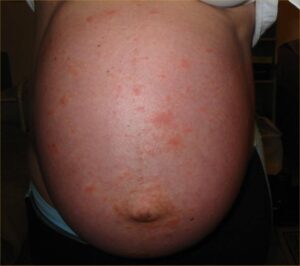
Your Answer: Polymorphic Eruption of Pregnancy
Explanation:This is Polymorphic Eruption of Pregnancy (PEP) also known as Pruritic Urticarial Papules and Plaques of Pregnancy (PUPPP). Papules and plaques form on the abdomen (commonly within striae). It is most common in women during their first pregnancy and typically occurs in the 3rd trimester.
-
This question is part of the following fields:
- Clinical Management
-
-
Question 50
Incorrect
-
When deciding on entry method for laparoscopy a patients build is important. Which of the following entry methods is inappropriately matched to the patient?
Your Answer: Palmers point entry into obese patient (BMI 42)
Correct Answer: Varess needle entry in a very thin patient (BMI 16)
Explanation:In patients with normal BMI there is no preferential entry method. The Varess technique is not appropriate for morbidly obese or very thin patients for the reasons set out below: Morbid Obesity (BMI>40): Hasson technique or entry at Palmers point Reason: difficult penetration with Varess needle Very Thin Patients: Hasson technique or insertion at Palmers point Reason: higher risk of vascular injury
-
This question is part of the following fields:
- Clinical Management
-
SESSION STATS - PERFORMANCE PER SPECIALTY
