-
Question 1
Incorrect
-
While evaluating a 33-year-old woman for infertility, you diagnose a bicornuate uterus. You explain that additional testing is necessary because of the woman's increased risk of congenital anomalies in which system?
Your Answer: Central nervous
Correct Answer: Urinary
Explanation:Bicornuate uterus is associated with an increased chance of urinary tract anomalies. Urinary tract anomalies were present in about 23.6% of cases of bicornuate uterus patients.
-
This question is part of the following fields:
- Embryology
-
-
Question 2
Incorrect
-
You are asked to review the early pregnancy ultrasound scan of a 27 year old lady. The transvaginal ultrasound results show a gestational sac of 26mm with no fetal pole and no fetal heartbeat. Which of the following is the most likely diagnosis?
Your Answer: Pregnancy of uncertain viability
Correct Answer: Miscarriage
Explanation:Ultrasound findings in early pregnancy can help determine the viability of an intrauterine pregnancy. In the absence of a fetal heartbeat and no visible fetal pole, the mean gestational sac diameter should be measured. A sac diameter of less than 25mm on a transvaginal ultrasound scan is likely an indication of a miscarriage. In the presence of a fetal heartbeat, the crown-rump length should be less than 7mm according to NICE guidelines. Further scans are indicated 14 days later to confirm the diagnosis. The diagnosis of ‘pregnancy of uncertain viability’ is given in situations where there is inadequate ultrasound evidence to diagnose a miscarriage, such as a developing sac but no visualisation of a foetus with a heartbeat.
Ultrasound findings for partial molar pregnancy are an enlarged placenta with multiple diffuse anechogenic patches, while findings in a complete molar pregnancy include an enlarged uterus with multiple small anechogenic spaces (snowstorm appearance), or the bunch of grapes sign representing hydropic trophoblastic villi. -
This question is part of the following fields:
- Data Interpretation
-
-
Question 3
Correct
-
A 24 year old patient decides to take a Chlamydia screening test whilst in the GP surgery. He is asymptomatic. The results are positive for chlamydia infection. His partner attends for testing and wants to know the risk of contracting Chlamydia. What is the risk of chlamydia infection following intercourse with an asymptomatic chlamydia positive partner?
Your Answer: 65%
Explanation:The chances of transmitting chlamydia from an asymptomatic partner through sexual intercourse is 65%.
-
This question is part of the following fields:
- Clinical Management
-
-
Question 4
Incorrect
-
A 46-year-old woman presents to your clinic with a complaint of irregular heavy menstruation. She had normal menstrual pattern 6 months back. Physical examination revealed no abnormality with a negative cervical smear. Laboratory investigation reveals a haemoglobin of 105g/L (Normal 115-165g/L). The most common cause of such menorrhagia is?
Your Answer: Endometrial carcinoma.
Correct Answer: Anovulatory cycles.
Explanation:Menorrhagia in a 45-year-old woman is most likely caused by an ovulation issue, most likely anovulatory cycles, particularly if the periods have grown irregular.
Endometrial carcinoma is a rare cause of menorrhagia that usually occurs after menopause.
Menorrhagia can be caused by fibroids, endometrial polyps, and adenomyosis, although the cycles are normally regular, and a dramatic change from normal cycles six months prior would be exceptional.
If fibroids or adenomyosis are the source of the menorrhagia, the uterus is usually enlarged. -
This question is part of the following fields:
- Gynaecology
-
-
Question 5
Correct
-
When is the highest risk of maternal-fetal transmission of Toxoplasma Gondii during pregnancy?
Your Answer: 26-40 weeks
Explanation:The risk of transplacental transmission from mother to foetus is greater in later pregnancy i.e. 26-40 weeks. Although the risk of transmission is lower in early pregnancy, if infection does occur earlier, particularly before 10 weeks, then complications are typically more severe.
-
This question is part of the following fields:
- Microbiology
-
-
Question 6
Correct
-
Regarding blood volume in pregnancy which of the following statements is TRUE?
Your Answer: Blood volume slowly increases by 40-50%
Explanation:Maternal blood volume expands during pregnancy to allow adequate perfusion of vital organs, including the placenta and foetus, and to anticipate blood loss associated with delivery. The rapid expansion of blood volume begins at 6–8 weeks gestation and plateaus at 32–34 weeks gestation. While there is some increase in intracellular water, the most marked expansion occurs in extracellular fluid volume, especially circulating plasma volume. This expanded extracellular fluid volume accounts for between 8 and 10 kg of the average maternal weight gain during pregnancy. Overall, total body water increases from 6.5 to 8.5 L by the end of pregnancy.
-
This question is part of the following fields:
- Physiology
-
-
Question 7
Correct
-
A 39-week pregnant patient presents with acute epigastric pain and general signs of malaise. She has a normal body temperature but clinical examination shows RUQ tenderness. Blood tests revealed a mild anaemia, high liver enzyme values, low platelets and haemolysis. What is the most possible diagnosis?
Your Answer: HELLP syndrome
Explanation:HELLP syndrome stands for haemolysis, elevated liver enzyme levels, and low platelet levels and is a very severe condition that can happen during pregnancy. Management of this condition requires immediate delivery of the baby.
-
This question is part of the following fields:
- Obstetrics
-
-
Question 8
Correct
-
Regarding heart rate in pregnancy which of the following statements is true?
Your Answer: Heart rate increases by 15 beats per minute
Explanation:The following cardiovascular changes occur during pregnancy:
– Blood volume slowly increases by 40-50%
– Heart rate rises by 15 beats/min above baseline
– Stroke volume increases by 25-30%
– Cardiac output increases by approximately 30-50%
– Systemic vascular resistance (SVR) decreases by 20-30%
– Diastolic blood pressure consequently decreases between 12 and 26 weeks but increases again to pre-pregnancy levels by 36 weeks.
As most of the changes occur in the first 12 weeks of gestation cardiac problems are likely to present in early pregnancy -
This question is part of the following fields:
- Physiology
-
-
Question 9
Correct
-
After birth, all of the following vessels constrict, EXCEPT the:
Your Answer: Hepatic portal vein
Explanation:Immediately after birth the liver is deprived of the large flow of blood supplied during foetal development via the umbilical vein and portal sinus. Simultaneously the blood pressure in the portal sinus, previously as high as in the umbilical vein, falls.
-
This question is part of the following fields:
- Physiology
-
-
Question 10
Correct
-
A diminishing blood volume within the first 4 hours post-partum may be seen when a warning sign occurs.
Which of the following is considered the single most important warning sign for the said situation?Your Answer: Tachycardia
Explanation:Postpartum haemorrhage (PPH) is a cumulative blood loss greater than 1000 mL with signs and symptoms of hypovolemia within 24 hours of the birth process, regardless of the route of delivery.
The first step in managing hemorrhagic shock is recognition. This should occur before the development of hypotension. Close attention should be paid to physiological responses to low blood volume. Tachycardia, tachypnoea, and narrowing pulse pressure may be the initial signs.
Tachycardia is typically the first abnormal vital sign of hemorrhagic shock. As the body attempts to preserve oxygen delivery to the brain and heart, blood is shunted away from extremities and nonvital organs. This causes cold and modelled extremities with delayed capillary refill. This shunting ultimately leads to worsening acidosis.
-
This question is part of the following fields:
- Obstetrics
-
-
Question 11
Correct
-
A 25-year-old female, expecting twins, complains of decreased fetal movements in her 40th week of gestation. An hour ago, she experienced constant abdominal pain for an hour and passed blood in her urine. What is the next best investigation in this case?
Your Answer: Cardiotocograph
Explanation:Cardiotocography (CTG) helps to record the heartbeat of the foetus in parallel to measuring the contractions of the mother’s uterus, this is the most appropriate tool to assess this patient’s condition.
-
This question is part of the following fields:
- Gynaecology
-
-
Question 12
Correct
-
Regarding pelvic inflammatory disease, which of the following is the tubal factor infertility rate?
Your Answer: 12.50%
Explanation:Pelvic inflammatory disease (PID) is a known risk factor in causing tubal infertility due to its role in tubal damage. The tubal infertility rate after one episode of PID is thought to be about 12.5%. After two episodes the risk increases to 25%, and 50% after three episodes. The usual causative agents are chlamydia and gonorrhoea.
-
This question is part of the following fields:
- Clinical Management
-
-
Question 13
Correct
-
In which one of the following circumstances, is it least likely for a foetus to be in a transverse lie?
Your Answer: A normal term foetus
Explanation:Normal position of the foetus in relationship to the mother is always a longitudinal lie and a cephalic presentation. Transverse lie means that the baby is sideways. The foetus lies transverse till 26-28th week of gestation, after which it usually changes its position from transverse to a longitudinal lie with head down. A transverse lie can occur in conditions like grand multiparity, preterm foetus, placenta previa and pelvic contraction.
-
This question is part of the following fields:
- Obstetrics
-
-
Question 14
Correct
-
Placental production of hPL, hCG, Oestrogen and Progesterone are examples of which type of mechanism
Your Answer: Endocrine
Explanation:Endocrine hormones are released from their site of origin and travel through the blood to act on other distant target organs. Autocrine hormones act within the same cell and exocrine glands secrete their products into ducts.
-
This question is part of the following fields:
- Endocrinology
-
-
Question 15
Correct
-
All of the following are autosomal recessive conditions EXCEPT which one?
Your Answer: Osteogenesis Imperfecta
Explanation:Osteogenesis imperfect is an autosomal dominant condition. All the rest of the options are autosomal recessive conditions.
-
This question is part of the following fields:
- Endocrinology
-
-
Question 16
Correct
-
A 30-year-old pregnant woman, at her 29th week of gestation, presents to physician with flu-like symptoms for the past 3 days along with runny nose, mild headache and she feels achy. She also has mild fever and diffuse rash all over her body. She is concerned about the health of her baby and wants to know if there are any safe medications which will make her feel better in a short time. She has received tetanus vaccination as part of antenatal care program since she immigrated at the end of her first trimester from Romania. Patient is otherwise healthy.
Considering the symptoms and travel history of this patient, she is at higher risk of giving birth to a newborn with which of the following options?Your Answer: Wide pulse pressure
Explanation:This pregnant woman likely has an infection with the rubella virus, which increases the risk of congenital rubella syndrome in her newborn. congenital heart diseases, particularly patent ductus arteriosus (PDA) is a part of this syndrome. Persistence of a patent vessel between the left pulmonary artery and aorta which is supposed to closes in the first 18 hours functionally and in the first 2–3 days of life anatomically is called as PDA.
Normally there is right to left shunting in utero, but in case of PDA blood is shunted from the left (aorta) to the right (pulmonary artery) due to the decrease in pulmonary vascular resistance after birth. This causes right ventricular hypertrophy, if left untreated it can lead to left ventricular hypertrophy and heart failure. There will be a continuous machine-like murmur, heard over the left upper sternal border, as the blood is shunted throughout cardiac cycle. Diastolic BP becomes lower than normal, leading to a higher pulse pressure which is felt as a bounding pulse due to the lost volume from aorta. Though PDA is a non-cyanotic condition, it may lead to Eisenmenger’s syndrome in which R to L shunting persists, resulting in cyanosis, clubbing and polycythemia. Treatment with nonsteroidal anti-inflammatory drugs like indomethacin can close patent PDA. Other symptoms in infants born with rubella syndrome are microcephaly and cataract.
The characteristic feature of an atrial septal defect or ASD, which is a congenital heart disease presenting as an opening in the septa between right and left atria, is a single fixed S2. There will be a delay in closure of the pulmonic valve, due to the excess amount of blood diverted to the right side.
Brachial-femoral delay is a finding in coarctation of aorta, which presents as hypertension in the upper extremities and hypotension in the lower extremities.
A double split S2 is a physiological finding caused by the closure of pulmonary and aortic valves on inspiration.
PDA and pulmonary artery stenosis are the most common cardiac defects reported along with congenital rubella syndrome (CRS), whereas tricuspid valve regurgitation is never reported along with it.
Learning objective: is associated with a continuous machine-like murmur heard over the left upper sternal border, bounding pulse and an increased pulse pressure are the usual symptoms associated with patent ductus arteriosus (PDA), which is mostly seen along with congenital rubella syndrome.
-
This question is part of the following fields:
- Obstetrics
-
-
Question 17
Correct
-
A 25-year-old pregnant woman presented to your clinic complaining of urinary symptoms at 19 weeks of gestation.
She is allergic to penicillin, with non-anaphylactic presentation.
Urine microscopy confirmed the diagnosis of urinary tract infection and culture result is pending.
From the options below, which is the most appropriate treatment for this patient?Your Answer: Cephalexin
Explanation:According to the laboratory reports, patient has developed urinary tract infection and should be treated with one week course of oral antibiotics.
As the patient is pregnant, antibiotics like cephalexin, co-amoxiclav and nitrofurantoin must be considered as these are safe during pregnancy.Due to this Patient’s allergic history to penicillin, cephalexin can be considered as the best option. Risk of cross allergy would have been higher if the patient had any history of anaphylactic reactions to penicillin.
In Australia, Amoxicillin is not recommended to treat UTI due to resistance.Tetracyclines also should be avoided during pregnancy due to its teratogenic property.
-
This question is part of the following fields:
- Obstetrics
-
-
Question 18
Incorrect
-
In early pregnancy at what gestation does the Embryonic pole become visible on transvaginal ultrasound?
Your Answer: 4 weeks + 3 days
Correct Answer: 5 weeks + 3 days
Explanation:The gestational sac can be visualized from as early as 4–5 weeks of gestation and the yolk sac at about 5 weeks (Figure 6.3). The embryo can be observed and measured at 5–6 weeks gestation.
-
This question is part of the following fields:
- Biophysics
-
-
Question 19
Correct
-
Question 20
Incorrect
-
How many days after fertilisation does the blastocyst hatch from the zone pellucida?
Your Answer: 14-21
Correct Answer: 5-Jul
Explanation:Shortly after the morula enters the uterus, around the 4th day after fertilization, a clear cystic cavity starts forming inside the morula. The fluid passes through the zona pellucida from the uterine cavity and hence forms the blastocyst.
-
This question is part of the following fields:
- Embryology
-
-
Question 21
Correct
-
A 27-year-old woman with primary infertility presents with secondary amenorrhoea that has been ongoing for twelve months. She states that she has been thinking about starting a family and was wondering if ovulation induction therapy was an option for her.
Which one of the following would be most valuable in predicting a poor response to ovulation induction therapy?Your Answer: Serum follicle-stimulating hormone (FSH).
Explanation:The tests listed can all be performed during the work-up of a woman with secondary amenorrhoea. They are useful in that they cam diagnosis the most likely cause for the amenorrhoea as well as guide the treatment required if the patient wanted to become pregnant. Of these, the hormone test best able to predict a poor response to ovulation-induction therapy is the follicle-stimulating hormone (FSH) assay. If there are high levels of FSH, most of the ovulation-induction therapies are ineffective, although the rare spontaneous pregnancy can occur.
To maximise the chance of pregnancy in patients with elevated FSH levels, the most effective technique is an ovum donation from a young woman. The ovum would be fertilised in the laboratory and transferred to the uterus of the woman with the high FSH level after administering hormonal preparation of her uterus.
If the FSH level is normal, ovulation-induction therapy is usually effective. For these patients, correction of thyroid function will be necessary if the thyroid function is not normal. Dopamine agonist therapy is indicated if the prolactin level is elevated. Clomiphene or gonadotrophin therapy can be used where the luteinising and oestradiol levels are low, normal, or minimally elevated.
-
This question is part of the following fields:
- Gynaecology
-
-
Question 22
Correct
-
A 24 year old who is 32 weeks pregnant presents with a rash to the abdomen. Looking at the picture below what is the diagnosis?
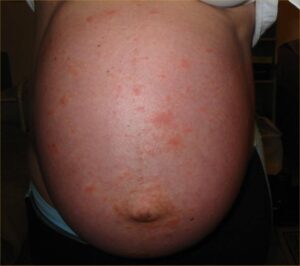
Your Answer: Polymorphic Eruption of Pregnancy
Explanation:This is Polymorphic Eruption of Pregnancy (PEP) also known as Pruritic Urticarial Papules and Plaques of Pregnancy (PUPPP). Papules and plaques form on the abdomen (commonly within striae). It is most common in women during their first pregnancy and typically occurs in the 3rd trimester.
-
This question is part of the following fields:
- Clinical Management
-
-
Question 23
Incorrect
-
Which of the following statements regarding hormone replacement therapy in postmenopausal women at the age of 55 is incorrect?
Your Answer: In women who are more than 3 years post menopause, raloxifene is effective in reducing vertebral fracture risk
Correct Answer: Combination with Alendronate is usually encouraged
Explanation:Taking hormone replacement therapy for more than 5 years can increase the risk of developing breast cancer. HRT is not recommended as treatment for osteoporosis alone in postmenopausal women older than 60. Raloxifene reduces risk of vertebral fracture in post menopausal women.
-
This question is part of the following fields:
- Gynaecology
-
-
Question 24
Correct
-
Oxytocin binds to what receptor type?
Your Answer: G-protein-coupled receptors
Explanation:Oxytocin binds to the G protein coupled receptors that triggers the IP3 mechanism leading to an elevated intracellular calcium ion.
-
This question is part of the following fields:
- Clinical Management
-
-
Question 25
Correct
-
All of the following are considered complications related to cigarette smoking affecting mothers during pregnancy, except:
Your Answer: Less likely to die of sudden infant death syndrome
Explanation:The effects of smoking on the outcomes of pregnancy are well documented and include an increased risk of preterm premature rupture of the membranes (PPROM), preterm birth, low birth weight, placenta previa, and placental abruption. Many studies have shown that the risk of Sudden Infant Death Syndrome (SIDS) is increased by maternal smoking during pregnancy.
-
This question is part of the following fields:
- Obstetrics
-
-
Question 26
Incorrect
-
Question 27
Correct
-
Which of the following hormones is secreted by the corpus luteum in a non pregnant state?
Your Answer: Progesterone
Explanation:The corpus luteum is formed from the granulosa cells of the mature follicle. The structure functions as a transient endocrine organ which secretes mainly progesterone with additional secretion of oestradiol and inhibin, which serve to suppress FSH levels. In the event of no pregnancy, the corpus luteum stops producing progesterone and degenerates into the corpus albicans.
-
This question is part of the following fields:
- Embryology
-
-
Question 28
Correct
-
Question 29
Correct
-
A 15 year old girl is being investigated for primary amenorrhoea. She has normal FSH,LH and E2 levels on hormone profiling and normal secondary sexual characteristics. An ultrasound shows no uterus. What is the likely diagnosis?
Your Answer: Rokitansky-Kuster-Hauser syndrome
Explanation:Mullerian agenesis occurs in 1 in 5000 to 1 in 40000 girls. The Mullerian system does not develop which results in an absent uterus and upper vagina. This condition is also known as Rokitansky-Kuster-Hauser syndrome, The ovarian function is normal and so the most common presentation is amenorrhea in the presence of an otherwise normal pubertal development.
-
This question is part of the following fields:
- Embryology
-
-
Question 30
Correct
-
In evaluating a reproductive age woman who presents with amenorrhea, which of the following conditions will result in a positive (withdrawal) progesterone challenge test?
Your Answer: Polycystic ovarian syndrome
Explanation:In pregnancy, progesterone is produced by the corpus luteum followed by the placenta- Exogenous progesterone will not lead to withdrawal bleeding. In ovarian failure as well as pituitary failure, no oestrogen stimulation of the endometrium exists, and progesterone cannot cause withdrawal bleeding. With Mullerian agenesis, there is no endometrium. Polycystic ovarian syndrome has an abundance of circulating oestrogen, so the endometrium will proliferate.
→ In pregnancy progesterone withdrawal will not occur since the corpus luteum is producing progesterone- The placenta will take over, starting at 7 weeks, and will be the sole producer of progesterone by 12 weeks.
→ In ovarian failure no oestrogen will be produced; no proliferation of the endometrium will occur.
→ Pituitary failure is an incorrect answer because without gonadotropin stimulation, there will not be enough oestrogen to stimulate the endometrial lining.
→ Mullerian agenesis is an incorrect answer – there is no uterus, thus no bleeding. -
This question is part of the following fields:
- Gynaecology
-
SESSION STATS - PERFORMANCE PER SPECIALTY
