-
Question 1
Correct
-
What is the normal pH value of an umbilical arterial sample of a new born term baby?
Your Answer: 7.2
Explanation:The normal range for a term baby is pH: 7.18 – 7.38, and preterm pH: 7.14 – 7.4. A pH below 7.1 therefore indicates acidosis.
-
This question is part of the following fields:
- Physiology
-
-
Question 2
Correct
-
A 75 year old woman has a lesion biopsied from the cervix that is histologically confirmed as endometrial carcinoma. Further staging investigations shows no spread to the serosa or adnexa, no spread to the para-aortic, pelvic or inguinal lymph nodes and no evidence of distant metastasis. What FIGO stage is this?
Your Answer: 2
Explanation:It is stage 2 of the disease.
Staging:
1 Confined to uterus
1A < 50% myometrial invasion
1B > 50% myometrial invasion
2 Cervical stromal invasion but not beyond uterus
3 Extension beyond the uterus
3A Tumour invades the serosa or adnexa
3B Vaginal and/or parametrial invasion
3C1 Pelvic nodal involvement
3C2 Para aortic nodal involvement
4 Distant Metastasis
4A Tumour invasion of the bladder and/or bowel mucosa
4B Distant metastases including abdominal metastases and/or inguinal lymph nodes -
This question is part of the following fields:
- Clinical Management
-
-
Question 3
Correct
-
The chance of multiple pregnancy increases:
Your Answer: With advancing maternal age
Explanation:Dizygotic twin pregnancies are known to increase with age of the mother. Naturally conceived twins are thought to occur in a 0.3% rate in women under 25 years, 1.4% between 25 and 34, 3% between 34 and 39, and 4.1% in women in their 40s or over. We also know that at least 50% of all twin pregnancies are conceived through ART and that this proportion is probably higher for women in their 40s.
-
This question is part of the following fields:
- Obstetrics
-
-
Question 4
Incorrect
-
What is the Gold standard investigation to diagnose abnormal uterine bleeding?
Your Answer: Transvaginal ultrasound
Correct Answer: Hysteroscopy along with dilatation and curettage
Explanation:During the last decade hysteroscopy has become the tool of choice for the evaluation of the endometrial cavity, including for assessment of abnormal uterine bleeding (AUB). Many clinicians would consider that, in most patients, the combination of transvaginal sonography and out-patient endometrial biopsy with diagnostic hysteroscopy could replace the need for dilation and curettage. Hysteroscopy was reported to have sensitivity, specificity, negative predictive value and positive predictive value of 94.2, 88.8, 96.3 and 83.1% respectively, in predicting normal or abnormal endometrial histopathology.
The highest accuracy of hysteroscopy was in diagnosing endometrial polyps, whereas the worst result was in estimating hyperplasia. Therefore, since the incidence of focal lesions in patients with AUB is high, it seems that the most beneficial approach is to proceed with hysteroscopy complemented by endometrial biopsy early in the assessment of AUB.
Transabdominal and transvaginal ultrasounds can be used but are inferior to hysteroscopy.
Coagulation profile can only diagnose possible coagulopathies and pregnancy test can only diagnose pregnancy. All other causes can not be identified with these laboratory investigations.
-
This question is part of the following fields:
- Gynaecology
-
-
Question 5
Correct
-
A 6-year-old girl is brought to the emergency department for evaluation of vaginal discharge. She has had malodorous vaginal discharge and small amounts of vaginal bleeding for about a week. Her mother called the patient’s primary care provider and instructed to stop giving bubble baths to the child, however, the symptoms have not improved. Aside from the discharge, the girl is normal, she was toilet trained at age 2 and has had no episodes of incontinence. She started kindergarten a month ago. Mother informed that patient has no fever, abdominal pain, or dysuria.
On examination, the labia appear normal but a purulent, malodorous vaginal discharge is noted. Visual inspection with the child in knee-chest position shows a whitish foreign body inside the vaginal introitus.
Which among the following is the best next step in management of this patient?Your Answer: Irrigate with warmed fluid after local anesthetic application
Explanation:Vaginal spotting, malodorous vaginal discharge and no signs of trauma like lacerations are the clinical features of vaginal foreign bodies in prepubertal girls. The most common object found as foreign body is toilet paper and its management includes warm irrigation and vaginoscopy under sedation/anesthesia.
Common cause of vulvovaginitis in prepubertal girls are vaginal foreign bodies. Although other objects like small toys, hair bands, etc can be occasionally found, the most common vaginal foreign body is toilet paper. Symptoms like malodorous vaginal discharge, intermittent vaginal bleeding or spotting and urinary symptoms like dysuria are caused due to the chronic irritation caused by the foreign body (the whitish foreign body in this case) on the vaginal tissue.
An external pelvic examination is performed with the girl in a knee-chest or frog-leg position in cases of suspected vaginal foreign body. An attempt at removal, after application of a topical anesthetic in the vaginal introitus, using vaginal irrigation with warm fluid or a swab can be done in case of an easily visualized small foreign body like toilet paper. In cases were the age of the girl or the type of foreign body prohibit adequate clinical evaluation the patient should be sedated or given a general anesthesia for examination using a vaginoscope and the foreign body should be removed.
In cases where child abuse or neglect is suspected Child Protective Services should be contacted. Vaginal or rectal foreign bodies can be the initial presentation of sexual abuse; however in otherwise asymptomatic girls with no behavioral changes, urinary symptoms and vulvar or anal trauma, presence of toilet paper is not of an immediately concerning for abuse.
To evaluate pelvic or ovarian masses CT scan of the abdomen and pelvis can be used; but it is not indicated in evaluation of a vaginal foreign body.
Patients in there prepubertal age have a narrow vaginal introitus and sensitive hymenal tissue due to low estrogen levels, so speculum examinations should not be performed in such patients as it can result in significant discomfort and trauma.
Topical estrogen can be used in the treatment of urethral prolapse, which is a cause of vaginal bleeding in prepubertal girls. This diagnosis is unlikely in this case as those with urethral prolapse will present with a beefy red protrusion at the urethra and not a material in the vagina.
Prepubertal girls with retained toilet paper as a vaginal foreign body will present with symptoms like malodorous vaginal discharge and vaginal spotting secondary to irritation. Initial management is topical anaesthetic application and removal of foreign body either by vaginal irrigation with warm fluid or removal with a swab.
-
This question is part of the following fields:
- Obstetrics
-
-
Question 6
Correct
-
The pelvis includes which of the following bones:
Your Answer: Ilium, ischium, pubis, sacrum & coccyx
Explanation:The pelvic skeleton is formed posteriorly (in the area of the back), by the sacrum and the coccyx and laterally and anteriorly (forward and to the sides), by a pair of hip bones. Each hip bone consists of 3 sections, ilium, ischium, and pubis.
-
This question is part of the following fields:
- Anatomy
-
-
Question 7
Correct
-
A 22-year-old pregnant woman attends clinic for a fetal scan at 31 weeks. She complains of difficulty breathing and a distended belly. U/S scan was done showing polyhydramnios and an absent gastric bubble. What is the most likely diagnosis?
Your Answer: Oesophageal atresia
Explanation:Oesophageal atresia of the foetus interrupts the normal circulation of the amniotic fluid. This causes polyhydramnios and subsequent distension of the uterus impacting proper expansion of the lungs. This would explain the difficulty breathing.
-
This question is part of the following fields:
- Obstetrics
-
-
Question 8
Incorrect
-
You see a patient who gave birth earlier in the day. She was taken off warfarin during pregnancy and is currently on LMWH. She intends to breastfeed for the first 6-8 weeks and wants advice regarding restarting warfarin. Which of the following is appropriate?
Your Answer:
Correct Answer: Recommence warfarin in 5-7 days
Explanation:The use of anticoagulants during pregnancy is a complicated issue because warfarin is teratogenic if used in the first trimester, and is linked with fetal intracranial haemorrhage in the third trimester (mainly at doses 5 mg daily). Low molecular weight heparin may be insufficient at preventing thrombosis in women with mechanical prosthetic heart valves, where the risk of valve thrombus is 10 per cent. Anticoagulation is essential in patients with congenital heart disease who have pulmonary hypertension, or artificial valve replacements, and in those in or at risk of atrial fibrillation. The options are either to continue warfarin for the pregnancy, or replace it with heparin between 6 and 12 weeks gestation to avoid the teratogenic risk. Warfarin should be started a week after delivery.
-
This question is part of the following fields:
- Pharmacology
-
-
Question 9
Incorrect
-
A patient undergoes oophorectomy and the ovarian veins are ligated. Which vein does the left ovary drain into?
Your Answer:
Correct Answer: Left renal
Explanation:When it comes to questions on venous drainage the ovarian vein is likely to be a common question given its varied drainage depending on laterality. The right ovarian vein travels through the suspensory ligament of the ovary and generally joins the inferior vena cava whereas the left ovarian vein drains into the left renal vein.
-
This question is part of the following fields:
- Anatomy
-
-
Question 10
Incorrect
-
Where is Glucagon produced?
Your Answer:
Correct Answer: Islet alpha cells
Explanation:The alpha cells in the islets of Langerhans are responsible for the production and secretion of glucagon. The B cells secrete insulin, the D cells secrete somatostatin, and the F cells secrete pancreatic polypeptide. The B cells, which are the most common and account for 60–75% of the cells in the islets, are generally located in the centre of each islet.
-
This question is part of the following fields:
- Endocrinology
-
-
Question 11
Incorrect
-
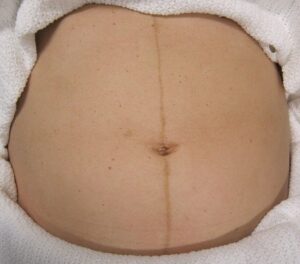
Looking at the picture below what is the diagnosis:
Your Answer:
Correct Answer: Linea Nigra
Explanation:This is Linea Nigra. It occurs in 3/4 of pregnancies and is due to increased melanocyte-stimulating hormone production by the placenta. This also causes melasma and darkening of the nipples.
-
This question is part of the following fields:
- Clinical Management
-
-
Question 12
Incorrect
-
During pregnancy which one of the following laboratory parameters is decreased?
Your Answer:
Correct Answer: Platelet count
Explanation:In pregnancy, although it is a hypercoagulable state with an increase in clotting factors, the platelet count is decreased. Fibrinogen and erythrocyte sedimentation rate (ESR) may be both increased.
-
This question is part of the following fields:
- Clinical Management
-
-
Question 13
Incorrect
-
A 27-year-old primigravida female presents to the emergency department at full term.
6 hours ago, she spontaneously began labour. The membranes ruptured two hours ago and the liquor was stained with meconium.
On cardiotocography (CTG) was conducted and it showed some intermittent late decelerations, from 140 to 110 beats/min.
On vaginal examination, her cervix id 5 cm dilated. The foetus is in cephalic presentation, in the left occipitotransverse (LOT) position, with the bony head at the level of the ischial spines (IS).
Due to the deceleration pattern, a fetal scalp pH estimation was performed and the pH was measured at 7.32.
An hour later, the CTG showed the following pattern over a period of 30 minutes:
Baseline 140/min
Baseline variability 1/min
Accelerations None evident
Decelerations Two decelerations were evident, with the heart rate falling to 80/min, and with each lasting 4 minutes
Another vaginal examination is conducted and her cervix is now 8cm dilated, but otherwise unchanged from one hour previously.
What would be the next best line management?Your Answer:
Correct Answer: Immediate delivery by Caesarean section.
Explanation:The next best line of management is immediate delivery via Caesarean section ( C section).
This is because of the change in cardiotocography (CTG). The pattern became much more severe with a virtual lack of short-term variability and prolonged decelerations. These changes indicate the necessity for an immediate C section as the cervix is not fully dilated.
As immediate delivery is indicated, another pH assessment is unnecessary as it would delay delivery and increase the likelihood of fetal hypoxia.
Delivery by ventose, in a primigravida where the cervix is only 8cm dilated is not indicated as it would allow the labour to proceed or augmenting with Syntocinon.
-
This question is part of the following fields:
- Obstetrics
-
-
Question 14
Incorrect
-
A woman comes to your office two weeks after undergoing a total vaginal hysterectomy with anterior colporrhaphy and the Burch surgery for uterine prolapse and stress urine incontinence.
Throughout the day, she complains of a continual loss of urine. She denies having any dysuria or urgency. Which of the following is the most likely cause of the problem?Your Answer:
Correct Answer: Vesicovaginal fistula
Explanation:Vesicovaginal fistula (VVF) is a subtype of female urogenital fistula (UGF). VVF is an abnormal fistulous tract extending between the bladder and the vagina that allows the continuous involuntary discharge of urine into the vaginal vault. The uncontrolled leakage of urine into the vagina is the hallmark symptom of patients with UGFs. Patients may complain of urinary incontinence or an increase in vaginal discharge following pelvic surgery or pelvic radiotherapy with or without antecedent surgery. The drainage may be continuous; however, in the presence of a very small UGF, it may be intermittent. Increased postoperative abdominal, pelvic, or flank pain; prolonged ileus; and fever should alert the physician to possible urinoma or urine ascites and mandates expeditious evaluation. Recurrent cystitis or pyelonephritis, abnormal urinary stream, and haematuria also should initiate a workup for UGF.
Urinary trace infection presents with dysuria and urgency.
Detrusor instability causes urge incontinence.
Neurogenic bladder from diabetic neuropathy would also have urgency. -
This question is part of the following fields:
- Gynaecology
-
-
Question 15
Incorrect
-
A 27-year-old woman admitted with per vaginal bleeding and left sided pelvic pain for 2 days. There was no history of fever. She gave a history of absent periods for past 8 weeks. Abdominal examination revealed guarding and rebound tenderness in left iliac region. There was left sided cervical excitation on vaginal examination. What is the most probable diagnosis?
Your Answer:
Correct Answer: Ectopic Pregnancy
Explanation:History of amenorrhoea, abdominal and vaginal examination are more favour of ectopic pregnancy. Endometriosis usually has a chronic cause and dysmenorrhoea. Salpingitis usually presents with fever. Ovarian torsion and ovarian tumours have different clinical presentations.
-
This question is part of the following fields:
- Gynaecology
-
-
Question 16
Incorrect
-
The ascending colon drains into the superior mesenteric vein (SMV). What vein does the SMV drain into?
Your Answer:
Correct Answer: Hepatic portal vein
Explanation:The superior mesenteric vein joins the splenic vein to form the hepatic portal vein.
-
This question is part of the following fields:
- Anatomy
-
-
Question 17
Incorrect
-
Which major hormone of pregnancy is produced by the placenta from 16-hydroxydehydroepiandrosterone sulphate (16-OH DHEAS)?
Your Answer:
Correct Answer: Estriol
Explanation:The placenta produces Estriol from 16-OH DHEAS. Estriol is the major oestrogen (oestrogen) of pregnancy and the placenta is the primary site of production. Pregnenolone is synthesised by the placenta from cholesterol and this is converted to dehydroepiandrosterone (DHEA) in the fetal adrenal gland
-
This question is part of the following fields:
- Endocrinology
-
-
Question 18
Incorrect
-
A 25-year-old Aboriginal woman at ten weeks of gestation presents with a 2-week history of nausea, vomiting and dizziness. She has not seen any doctor during this illness.
On examination, she is found to be dehydrated, her heart rate is 135 per minute (sinus tachycardia), blood pressure 96/60 mm of Hg with a postural drop of more than 20 mm of Hg systolic pressure and is unable to tolerate both liquids and solids.Urine contains ketones and blood tests are pending.
How will you manage this case?Your Answer:
Correct Answer: Give metoclopramide and intravenous normal saline
Explanation:Analysis of presentation shows the patient has developed hyperemesis gravidarum.
She is in early shock, presented as sinus tachycardia and hypotension, with ketonuria and requires immediate fluid resuscitation and anti-emetics. The first line fluid of choice is administration of normal saline 0.9%, and should avoid giving dextrose containing fluids as they can precipitate encephalopathy and worsens hyponatremia.The most appropriate management of a pregnant patient in this situation is administration of metoclopramide as the first line and Ondansetron as second line antiemetic, which are Australian category A and B1 drugs respectively. The following also should be considered and monitored for:
1. More refractory vomiting.
2. Failure to improve.
3. Recurrent hospital admissions.Steroids like prednisolone are third line medications which are used in resistant cases of hyperemesis gravidarum after proper consultation.
-
This question is part of the following fields:
- Obstetrics
-
-
Question 19
Incorrect
-
A 20-year-old primigravida at her 16 weeks of gestation, presented with the history of lower vaginal pressure, vaginal spotting and lower back pain.
Transvaginal ultrasound shows cervical shortening to 2 cm, cervical dilation, and protrusion of fetal membranes into the cervical canal. Findings confirms the woman has developed non-specific symptoms of cervical insufficiency which may lead to premature delivery.
Which among the following is the most appropriate management in this case?Your Answer:
Correct Answer: Reinforcement of the cervical ring with nonabsorbable suture material
Explanation:Patient mentioned in the given case has developed clinical features of cervical insufficiency and the possible treatment options include:
1- Cerclage, which is the technique used for the reinforcement of cervical ring with nonabsorbable suture material and is indicated based on ultrasonographic findings. It is the treatment of choice when cervical shortening is detected by ultrasonography before 22 to 24 weeks of gestation.2- Vaginal progesterone is used to reduce the risk of preterm delivery in women who have a prior history of idiopathic preterm delivery or cervical shortening, which is confirmed in the current pregnancy also by ultrasonography.This method is applicable only to those women who do not meet the criteria for Cerclage.
All the other options of management are incorrect in the given case.
-
This question is part of the following fields:
- Obstetrics
-
-
Question 20
Incorrect
-
A 27-year-old G2P1 visits the gynaecologist with complaints of increased hair growth on her face, breast, and belly, but hair loss in the temporal regions of her head. She has also struggled with acne.
On physical examination, the patient's face, chest, and belly are covered in coarse, dark hair. Her clitoris is swollen on pelvic examination. Her left adnexal mass is 7 cm in diameter.
What is the most likely ovarian tumour to be associated with this clinical picture?Your Answer:
Correct Answer: Sertoli-Leydig cell tumour
Explanation:Sertoli-Leydig cell tumours constitute less than 0.5 percent of ovarian neoplasms. They may behave in a benign or malignant fashion, which correlates with the degree of differentiation in an individual case. Approximately 75 percent occur in women under the age of 40 years (mean age at diagnosis is 25), but they occur in all age groups. The neoplasms are characterized by the presence of testicular structures that produce androgens. This can result in virilization, although not all of these neoplasms are functionally active.
Pure Sertoli cell tumours are usually estrogenic and may also secrete renin, leading to refractory hypertension and hypokalaemia. In addition, these tumours may be associated with Peutz-Jeghers syndrome.
Pure Leydig cell tumours are androgen secreting; only a few cases have been reported. Virtually all of these rare tumours are unilateral and confined to the ovary at diagnosis.
Granulosa cell tumours typically present as large masses; the mean diameter is 12 cm. Women may present with an asymptomatic mass noted on abdominal or pelvic examination. Granulosa cell tumours often produce oestrogen and/or progesterone; consequently, symptoms related to hyperestrogenism are common at diagnosis.
Krukenberg tumour, also known as carcinoma mucocellulare, refers to the signet ring subtype of metastatic tumour to the ovary. The stomach followed by colon are the two most common primary tumours to result in ovarian metastases, pursued by the breast, lung, and contralateral ovary.
A rare tumour that is made up of more than one type of cell found in the gonads (testicles and ovaries), including germ cells, stromal cells, and granulosa cells. Gonadoblastomas are usually benign (not cancer), but they may sometimes become malignant (cancer) if not treated.
-
This question is part of the following fields:
- Gynaecology
-
-
Question 21
Incorrect
-
Which of the following best describes the mechanism of action of Promethazine?
Your Answer:
Correct Answer: Histamine H1-receptor antagonist
Explanation:Promethazine is type of antihistamine that acts on the H1 receptor. In pregnancy NICE guidelines advise oral promethazine or oral cyclizine should be used as 1st line drug management of nausea and vomiting. Both are H1 antagonists.
-
This question is part of the following fields:
- Pharmacology
-
-
Question 22
Incorrect
-
With regard to the cell cycle. In what phase do chromatids get cleaved into chromosomes and pulled apart?
Your Answer:
Correct Answer: Anaphase
Explanation:Mitosis is the process during which cell division occurs. It is divided into 4 stages:
– The first stage is the prophase during which the chromosomes condense, mitotic spindles form and the chromosomes pair which each other.
– The second stage is the metaphase during which the chromatids align at the equatorial plane.
– The third stage is the anaphase during which the chromatids are separated into 2 daughter chromosomes.
– The fourth phase is the telophase during which the chromatids decondense and a new nuclear envelop forms around the each of the daughter chromosomes. Cytokinesis is the process during which the cell cytoplasm divides. -
This question is part of the following fields:
- Biochemistry
-
-
Question 23
Incorrect
-
Where is fetal DHEA produced?
Your Answer:
Correct Answer: Adrenals
Explanation:Dehydroepiandrosterone (DHEA) is a steroid hormone synthesised from cholesterol (via Pregnenolone) by the adrenal glands. The foetus manufactures DHEA, which stimulates the placenta to form oestrogen, thus keeping a pregnancy going. Production of DHEA stops at birth, then begins again around age seven and peaks when a person is in their mid-20s
-
This question is part of the following fields:
- Endocrinology
-
-
Question 24
Incorrect
-
You review a patient in the fertility clinic. The ultrasound and biochemical profile are consistent with PCOS. She has been trying to conceive for 2 years. Her BMI is 26 kg/m2. She is a non-smoker. Which of the following is the most appropriate first line treatment?
Your Answer:
Correct Answer: Clomiphene
Explanation:Clomiphene and/or Metformin are 1st line agents. Weight loss in the setting of subfertility is advised if BMI >30 kg/m2
-
This question is part of the following fields:
- Clinical Management
-
-
Question 25
Incorrect
-
Regarding blood volume in pregnancy which of the following statements is TRUE?
Your Answer:
Correct Answer: Blood volume slowly increases by 40-50%
Explanation:Maternal blood volume expands during pregnancy to allow adequate perfusion of vital organs, including the placenta and foetus, and to anticipate blood loss associated with delivery. The rapid expansion of blood volume begins at 6–8 weeks gestation and plateaus at 32–34 weeks gestation. While there is some increase in intracellular water, the most marked expansion occurs in extracellular fluid volume, especially circulating plasma volume. This expanded extracellular fluid volume accounts for between 8 and 10 kg of the average maternal weight gain during pregnancy. Overall, total body water increases from 6.5 to 8.5 L by the end of pregnancy.
-
This question is part of the following fields:
- Physiology
-
-
Question 26
Incorrect
-
Question 27
Incorrect
-
According to the RCOG Green-top guideline published in 2013 at what stage of gestation should pregnant patients with PCOS be offered screening for gestational diabetes
Your Answer:
Correct Answer: 24-28 weeks gestation
Explanation:Screening for gestational diabetes should be offered and performed between 24-28 weeks. It should be noted PCOS alone does not make screening essential. It is advised for PCOS patients who are overweight or if not overweight but has other risk factors (age >40, personal history of gestational diabetes or family history of type II diabetes). Screening is via a 2-hour post 75 g oral glucose tolerance test.
-
This question is part of the following fields:
- Clinical Management
-
-
Question 28
Incorrect
-
Question 29
Incorrect
-
A 42 years old woman presents to a gynaecologic clinic with mid-cycle, moderate-intensity abdominal pain. There is also a similar episode of pain around a month ago, which remained for about 3 days and resolved spontaneously. She is otherwise healthy with a normal regular cycle of about 28 days duration.
Examination reveals normal vitals, soft and non-tender abdomen without any guarding or rebound tenderness.
The most likely cause of the patient's problem is?Your Answer:
Correct Answer: Ovulation pain
Explanation:This patient has developed symptoms of ovulation discomfort, which is also known as Mittelschmerz syndrome. Lower abdominal and pelvic pain that arises around the middle of a woman’s menstrual cycle characterises this condition.
The discomfort usually appears suddenly and disappears within hours, though it can continue up to three days.The symptoms of ovulation pain can include:
– Lower abdomen pain.
– The pain typically occurs about two weeks before the menstrual period is due.
– The pain is felt on the right or left side, depending on which ovary is releasing an egg.
– The pain may switch from one side to the other from one cycle to the next, or remain on one side for a few cycles.
The duration of pain ranges anywhere from minutes to 48 hours. -
This question is part of the following fields:
- Gynaecology
-
-
Question 30
Incorrect
-
A 32-year-old woman at 37 weeks of gestation, who has been fine antenatally, presented with a history of sudden onset of severe abdominal pain with vaginal bleeding, and cessation of contractions after 18 hours of active pushing at home.
On examination, she is conscious and pale.
Her vital signs include blood pressure of 70/45 mm of Hg and a pulse rate of 115 beats per minute which is weak.
Her abdomen is irregularly distended, with both shifting dullness and fluid thrill present. Fetal heart sounds are not audible.
What will be the most likely diagnosis?Your Answer:
Correct Answer: Uterine rupture
Explanation:Patient’s presentation is classic for uterine rupture, were she developed sudden abdominal pain followed by cessation of contractions, termination of urge to push and vaginal bleeding.
Abdominal examination shows no fetal cardiac activity and signs of fluid collection like fluid thrill and shifting dullness. The fluid collected will be blood, which usually enters the peritoneum after the rupture of the uterus. In such patients vaginal examination will reveal a range of cervical dilatation with evidences of cephalopelvic disproportion.
Anterior lower transverse segment is the most common site for spontaneous uterine rupture. Patient in the case presenting with tachycardia and hypotension is in shock due to blood loss and will require urgent resuscitation.Placenta previa presents with painless bleeding from the vagina and Placental abruption will present with painful vaginal bleeding with tender and tense uterine wall, however, in contrary to that of uterine rupture, uterine contractions will continue in both these cases.
Shoulder dystocia is more likely to present in a prolonged labour with a significant delay in the progress of labour. However, in this case, there is no mention of shoulder dystocia.
Disseminated intravascular coagulation (DIC) is a condition which is causes due to abnormal and excessive generation of thrombin and fibrin in the circulating blood which results in bleeding from every skin puncture sites. It results in increased platelet aggregation and consumption of coagulation factors which results in bleeding at some sites and thromboembolism at other sites. Placental abruption, or retained products of conception in the uterine cavity are the causes for DIC.
-
This question is part of the following fields:
- Obstetrics
-
SESSION STATS - PERFORMANCE PER SPECIALTY
