-
Question 1
Incorrect
-
Which of the following drugs is first line treatment for a stable regular broad-complex tachycardia:
Your Answer: Adenosine
Correct Answer: Amiodarone
Explanation:A regular broad-complex tachycardia is likely to be ventricular tachycardia or a regular supraventricular rhythm with bundle branch block. A ventricular tachycardia (or broad-complex tachycardia of uncertain origin) should be treated with amiodarone 300 mg IV over 10 – 60 min, followed by an infusion of 900 mg over the next 24 hours. If previously confirmed as SVT with bundle branch block, the patient should be treated as for narrow-complex tachycardia.
-
This question is part of the following fields:
- Cardiovascular
- Pharmacology
-
-
Question 2
Correct
-
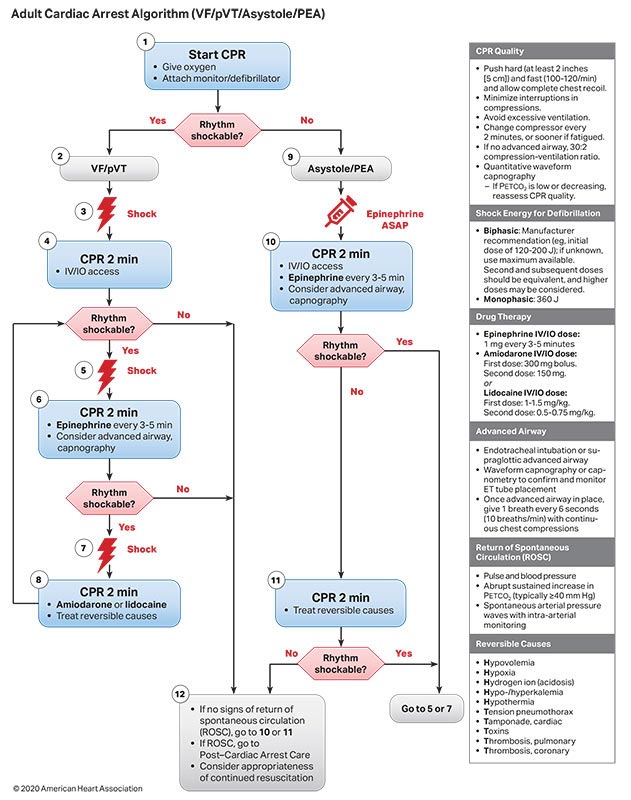
Which of the following conditions require IV Lidocaine administration?
Your Answer: Refractory ventricular fibrillation in cardiac arrest
Explanation:IV Lidocaine is indicated in Ventricular Arrhythmias or Pulseless Ventricular Tachycardia (after defibrillation, attempted CPR, and vasopressor administration)
-
This question is part of the following fields:
- Cardiovascular
- Pharmacology
-
-
Question 3
Correct
-
Blood flows from the left atrium into the left ventricle via:
Your Answer: The mitral valve
Explanation:Blood flows from the right atrium into the right ventricle via the tricuspid atrioventricular valve and from the left atrium into the left ventricle via the mitral atrioventricular valve. Blood is ejected from the right ventricle through the pulmonary semilunar valve into the pulmonary artery and from the left ventricle via the aortic semilunar valve into the aorta.
-
This question is part of the following fields:
- Cardiovascular
- Physiology
-
-
Question 4
Incorrect
-
On which of the following is preload primarily dependent?
Your Answer: Stroke volume
Correct Answer: End-diastolic volume
Explanation:Preload refers to the initial stretching of the cardiac myocytes before contraction. It is therefore related to muscle sarcomere length. The sarcomere length cannot be determined in the intact heart, and so, other indices of preload are used, like ventricular end-diastolic volume or pressure. The end-diastolic pressure and volume of the ventricles increase when venous return to the heart is increased, and this stretches the sarcomeres, which increase their preload.
-
This question is part of the following fields:
- Cardiovascular
- Physiology
-
-
Question 5
Correct
-
What is the most common application of Nitrates?
Your Answer: Angina
Explanation:In patients with exertional stable angina, nitrates improve exercise tolerance, time to onset of angina, and ST-segment depression during exercise testing. In combination with beta-blockers or calcium channel blockers, nitrates produce greater anti-anginal and anti-ischemic effects.
While they act as vasodilators, coronary vasodilators, and modest arteriolar dilators, the primary anti ischemic effect of nitrates is to decrease myocardial oxygen demand by producing systemic vasodilation more than coronary vasodilation. This systemic vasodilation reduces left ventricular systolic wall stress. -
This question is part of the following fields:
- Cardiovascular
- Pharmacology
-
-
Question 6
Incorrect
-
Which of the following is NOT a benefit of low molecular weight heparin (LMWH) over unfractionated heparin therapy:
Your Answer: It has less interaction with platelet function.
Correct Answer: Its effects can be rapidly and completely reversed with protamine sulfate.
Explanation:Advantages of LMWHGreater ability to inhibit factor Xa directly, interacting less with platelets and so may have a lesser tendency to cause bleedingGreater bioavailability and longer half-life in plasma making once daily subcutaneous administration possibleMore predictable dose response avoiding the need for routine anticoagulant monitoringLower associated risk of heparin-induced thrombocytopenia or of osteoporosis
-
This question is part of the following fields:
- Cardiovascular
- Pharmacology
-
-
Question 7
Incorrect
-
Regarding postural hypotension, which of the following statements is INCORRECT:
Your Answer: Postural hypotension is usually corrected quickly by the baroreceptor reflex.
Correct Answer: Postural hypotension usually causes a reflex bradycardia.
Explanation:On standing from a prone position, gravity causes blood to pool in veins in the legs. Central venous pressure (CVP) falls, causing a fall in stroke volume and cardiac output (due to Starling’s law) and thus a fall in blood pressure. Normally this fall in BP is rapidly corrected by the baroreceptor reflex which causes venoconstriction (partially restoring CVP), and an increase in heart rate and contractility, so restoring cardiac output and blood pressure. Impaired autonomic nervous activity in the elderly accounts for the greater likelihood of postural hypotension. Any symptoms of dizziness, blurred vision or syncope is due to a transient fall in cerebral perfusion that occurs before cardiac output and mean arterial pressure (MAP) can be corrected.
-
This question is part of the following fields:
- Cardiovascular
- Physiology
-
-
Question 8
Correct
-
All of the following are indications for beta-blockers EXCEPT for:
Your Answer: Raynaud's disease
Explanation:Beta-blockers are contraindicated in Raynaud’s syndrome.
Beta-blockers may be indicated in:
Hypertension
Pheochromocytoma (only with an alpha-blocker)
Angina
Secondary prevention after ACS
Arrhythmias including atrial fibrillation
Heart failure
Thyrotoxicosis
Anxiety
Prophylaxis of migraine
Essential tremor
Glaucoma -
This question is part of the following fields:
- Cardiovascular
- Pharmacology
-
-
Question 9
Incorrect
-
Which of the following is NOT a common side effect of amiodarone:
Your Answer: Slate grey skin discolouration
Correct Answer: Blue/green teeth discolouration
Explanation:Common side effects of amiodarone include: Bradycardia, Nausea and vomiting, Thyroid disorders – hypothyroidism and hyperthyroidism, Persistent slate grey skin discoloration, Photosensitivity, Pulmonary toxicity (including pneumonitis and fibrosis), Hepatotoxicity, Corneal microdeposits (sometimes with night glare), Peripheral neuropathy and Sleep disorders.
-
This question is part of the following fields:
- Cardiovascular
- Pharmacology
-
-
Question 10
Incorrect
-
A 60-year-old patient had a sudden onset of palpitations and shortness of breath. He had a history of poorly controlled hypertension and ischemic heart disease. His ECG also shows atrial fibrillation. Based on the patient’s condition, which pharmacologic cardioversion would be best to use?
Your Answer: Digoxin
Correct Answer: Amiodarone
Explanation:Chemical cardioversion, or pharmacologic cardioversion, is the treatment of abnormal heart rhythms using drugs.
Flecainide and propafenone are examples of drugs used as chemical cardioverters.
However, given the situation of the patient, these drugs are contraindicated for his ischaemic heart disease. Amiodarone is also an antiarrhythmic drug and is the best choice for this situation.
-
This question is part of the following fields:
- Cardiovascular
- Pharmacology
-
-
Question 11
Correct
-
Which of the following is NOT a common side effect of adenosine:
Your Answer: Yellow vision
Explanation:Common side effects of adenosine include:
Apprehension
Dizziness, flushing, headache, nausea, dyspnoea
Angina (discontinue)
AV block, sinus pause and arrhythmia (discontinue if asystole or severe bradycardia occur) -
This question is part of the following fields:
- Cardiovascular
- Pharmacology
-
-
Question 12
Incorrect
-
Which of the following drug classes may cause bronchoconstriction:
Your Answer: Alpha-blocker
Correct Answer: Beta-blockers
Explanation:Beta-blockers, including those considered to be cardioselective, should usually be avoided in patients with a history of asthma, bronchospasm or a history of obstructive airways disease. However, when there is no alternative, a cardioselective beta-blocker can be given to these patients with caution and under specialist supervision. In such cases the risk of inducing bronchospasm should be appreciated and appropriate precautions taken.
-
This question is part of the following fields:
- Cardiovascular
- Pharmacology
-
-
Question 13
Incorrect
-
When an elderly dehydrated patient is moved from a supine to a standing position, her heart rate increases. Which of the following accounts for the increase in heart rate upon standing:
Your Answer: Decreased total peripheral resistance
Correct Answer: Decreased venous return
Explanation:On standing from a prone position, gravity causes blood to pool in veins in the legs. Central venous pressure (CVP) falls, causing a fall in stroke volume and cardiac output (due to Starling’s law) and thus a fall in blood pressure. Normally this fall in BP is rapidly corrected by the baroreceptor reflex which causes venoconstriction (partially restoring CVP), and an increase in heart rate and contractility, so restoring cardiac output and blood pressure. Impaired autonomic nervous activity in the elderly accounts for the greater likelihood of postural hypotension. Any symptoms of dizziness, blurred vision or syncope is due to a transient fall in cerebral perfusion that occurs before cardiac output and mean arterial pressure (MAP) can be corrected.
-
This question is part of the following fields:
- Cardiovascular
- Physiology
-
-
Question 14
Incorrect
-
Regarding alteplase, which of the following statements is INCORRECT:
Your Answer: Alteplase has selectivity for activation of fibrin-bound plasminogen.
Correct Answer: Alteplase is commonly associated with hypotensive effects.
Explanation:Alteplase is a recombinant tissue-type plasminogen activator (tPA), a naturally occurring fibrin-specific enzyme that has selectivity for activation of fibrin-bound plasminogen. It has a short half-life of 3 – 4 minutes and must be given by continuous intravenous infusion but is not associated with antigenic or hypotensive effects, and can be used in patients when recent streptococcal infections or recent use of streptokinase contraindicates the use of streptokinase.
-
This question is part of the following fields:
- Cardiovascular
- Pharmacology
-
-
Question 15
Correct
-
Lidocaine's antiarrhythmic mode of action is as follows:
Your Answer: Blocks inactivated Na+ channels
Explanation:Lidocaine is a class 1B antidysrhythmic; combines with fast Na channels and thereby inhibits recovery after repolarization, resulting in decreasing myocardial excitability and conduction velocity. However, in ischaemic areas, where anoxia causes depolarisation and arrhythmogenic activity, many Na+ channels are inactivated and therefore susceptible to lidocaine.
-
This question is part of the following fields:
- Cardiovascular
- Pharmacology
-
-
Question 16
Incorrect
-
In ventricular myocytes, the plateau phase of the action potential comes about through which of the following:
Your Answer: Opening of voltage-gated Na + channels
Correct Answer: Opening of voltage-gated Ca 2+ channels
Explanation:After the intial upstroke of the action potential, Na+channels and currents rapidly inactivate, but in cardiac myocytes, the initial depolarisation activates voltage-gated Ca2+channels (slow L-type channels, threshold approximately – 45 mV) through which Ca2+floods into the cell. The resulting influx of Ca2+prevents the cell from repolarising and causes a plateau phase, that is maintained for about 250 ms until the L-type channels inactivate. The cardiac AP is thus much longer than that in nerve or skeletal muscle.
-
This question is part of the following fields:
- Cardiovascular
- Physiology
-
-
Question 17
Correct
-
Which of the following best describes the correct administration of adrenaline for a shockable rhythm in adult advanced life support?
Your Answer: Give 1 mg of adrenaline after the second shock and every 3 - 5 minutes thereafter
Explanation:Give adrenaline 1 mg IV (IO) (10 mL of 1:10,000 solution) after the 2nd shock for adult patients in cardiac arrest with a shockable rhythm. Repeat adrenaline 1 mg IV (IO) every 3-5 minutes whilst ALS continues.
-
This question is part of the following fields:
- Cardiovascular
- Pharmacology
-
-
Question 18
Incorrect
-
Which of the following is most true of the sinoatrial node:
Your Answer: It is a region of specialised nerve cells that can initiate an impulse.
Correct Answer: Frequency of depolarisation is increased by sympathetic stimulation.
Explanation:Cardiac myocyte contraction is not dependent on an external nerve supply but instead the heart generates its own rhythm, demonstrating inherent rhythmicity. The heartbeat is initiated by spontaneous depolarisation of the sinoatrial node (SAN), a region of specialised myocytes in the right atrium close to the coronary sinus, at a rate of 100-110 beats/min. This intrinsic rhythm is primarily influenced by autonomic nerves, with vagal influences being dominant over sympathetic influences at rest. This vagal tone reduces the resting heart rate down to 60-80 beats/min. To increase heart rate, the autonomic nervous system increases sympathetic outflow to the SAN, with concurrent inhibition of vagal tone. These changes mean the pacemaker potential more rapidly reaches the threshold for action potential generation.
-
This question is part of the following fields:
- Cardiovascular
- Physiology
-
-
Question 19
Correct
-
Discontinuous capillaries are typically found where in the body:
Your Answer: Reticuloendothelial system
Explanation:Discontinuous capillaries, found in the reticuloendothelial system (bone marrow, liver and spleen), have large gaps between endothelial cells and are permeable to red blood cells.
-
This question is part of the following fields:
- Cardiovascular
- Physiology
-
-
Question 20
Incorrect
-
As a response to low blood pressure, the baroreceptor reflex will facilitate vasoconstriction by activating which receptor?
Your Answer:
Correct Answer: Alpha1
Explanation:The rate of baroreceptor firing slows down when blood pressure falls too low. This causes an increase in sympathetic stimulation of the heart, resulting in an increase in cardiac output. It also causes vasoconstriction by activating alpha 1 receptors in smooth muscle, which causes sympathetic stimulation of peripheral vessels.
Alpha2 receptors can be found in both the brain and the peripheral nervous system. They control sympathetic outflow in the brain stem.
Beta1 receptors, which are found on the cell membrane of cardiac muscle cells, stimulate heart rate and myocardial contractility. The smooth muscle cell membrane contains beta2 receptors, which promote smooth muscle relaxation in the lungs causing bronchodilation, GI tract, and peripheral blood vessels.
-
This question is part of the following fields:
- Cardiovascular
- Physiology
-
SESSION STATS - PERFORMANCE PER SPECIALTY
